
To Create, You Must Destroy: Andrés Faustinelli on the Birth of BEAR-BON Whisky
There's a philosophy at the heart of how Andrés Faustinelli makes whisky. "When you create, you need to destroy," the Master Blender of BEARFACE says. "There is a destructive process in the creation process. You need to forget about what you have been doing, to do something new."
It's a bold statement from a man who has spent years perfecting one of Canada's most decorated whisky expressions. Since pioneering Elementally Aged® BEARFACE Triple Oak in 2018, Faustinelli has continued to push boundaries through the brand's Wilderness Series releases. But with BEARFACE BEAR-BON™ Charred Barrel Whisky, he has done something categorically different. He has dismantled his own framework and rebuilt it from the ground up — questioning every assumption that underpinned the BEARFACE story so far.
The Other Road Not Taken
When Faustinelli first developed BEARFACE Triple Oak in 2018, he faced a foundational creative decision: grain diversity or oak diversity. He chose oak, deploying three distinct barrels to sculpt the whisky's character. BEAR-BON is the answer to the question he didn't ask back then.
"I always had the choice to add more grains," he explains. "Instead of using rye, I wanted to use Hungarian oak to bring spice. BEAR-BON is me asking myself — what if I had done things differently?"
Where Triple Oak is built on one grain and three oaks, BEAR-BON inverts the formula entirely: three grains, one very special cask. It is the mirror image of its predecessor; a yin to the other's yang.
A Solution Born from a Problem
The story of BEAR-BON begins at a hotel bar. Faustinelli was sitting with Kai Hahn, a winemaker at Mission Hill with whom he'd been collaborating for years, tasting individual grain components when the concept crystallised. "We started to think about how they could work together," he recalls, "and ended up with a base recipe on the back of a napkin."
But the deeper origin lies in a logistical challenge of what to do with the seasoned wine casks left over after making or recasking whisky for BEARFACE Triple Oak.
After holding three vintages of Okanagan red wine, these barrels are seasoned for up to two years with Elementally Aged whisky, a process that strips out the volatile, astringent wood notes that make wine casks so notoriously difficult to work with, leaving something deeply integrated and rich. Faustinelli had noticed there was a growing market in France for exactly these barrels; winemakers prize them precisely because whisky seasoning does the hard work of taming the wood. Rather than sell them on, he asked a different question: what if they charred them?
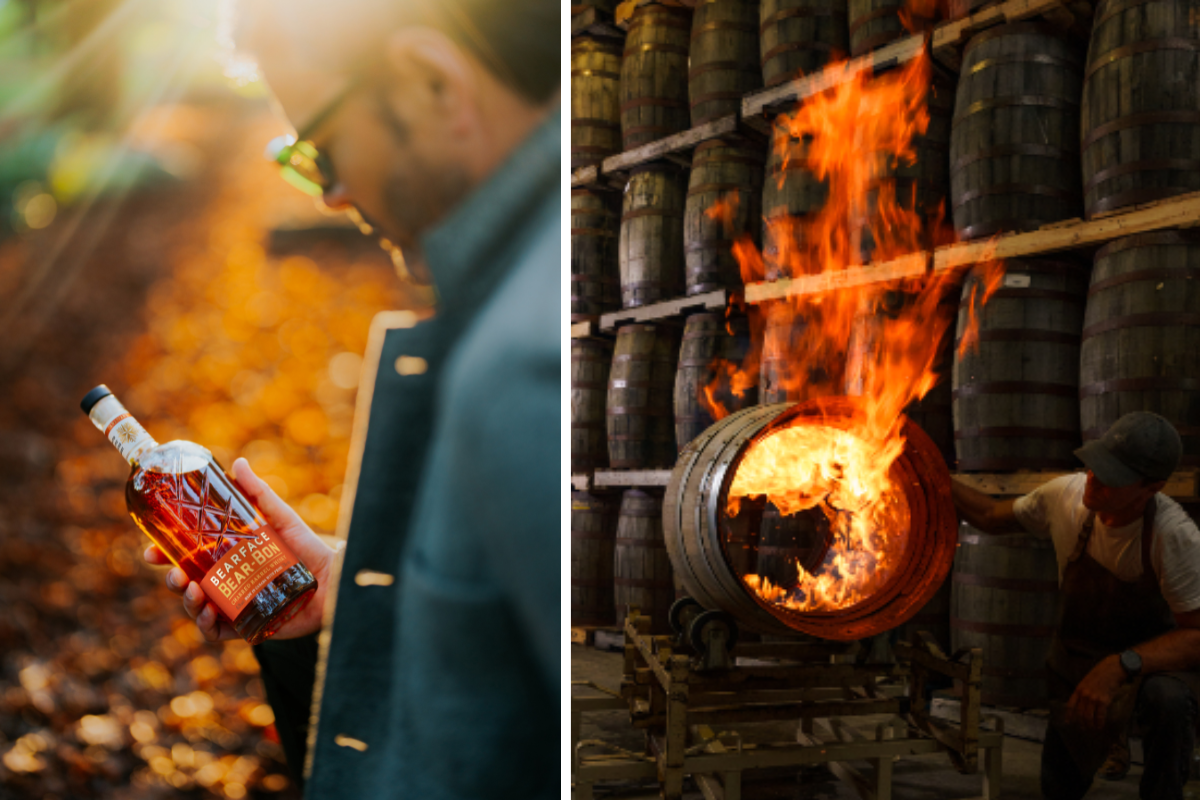
"We take the wine cask seasoned by wine for three vintages, then seasoned with whisky, and we char the staves over," he explains. "We were super impressed with the results." The hand-charring, carried out by legendary Canadian coopers in Quebec, transforms the toasted French oak into something unique and structural, unlocking dark caramel, toasted grain, and a depth that reads unmistakably bourbon-adjacent, while remaining distinctly Canadian.
Three Grains, One Cask, One Cycle
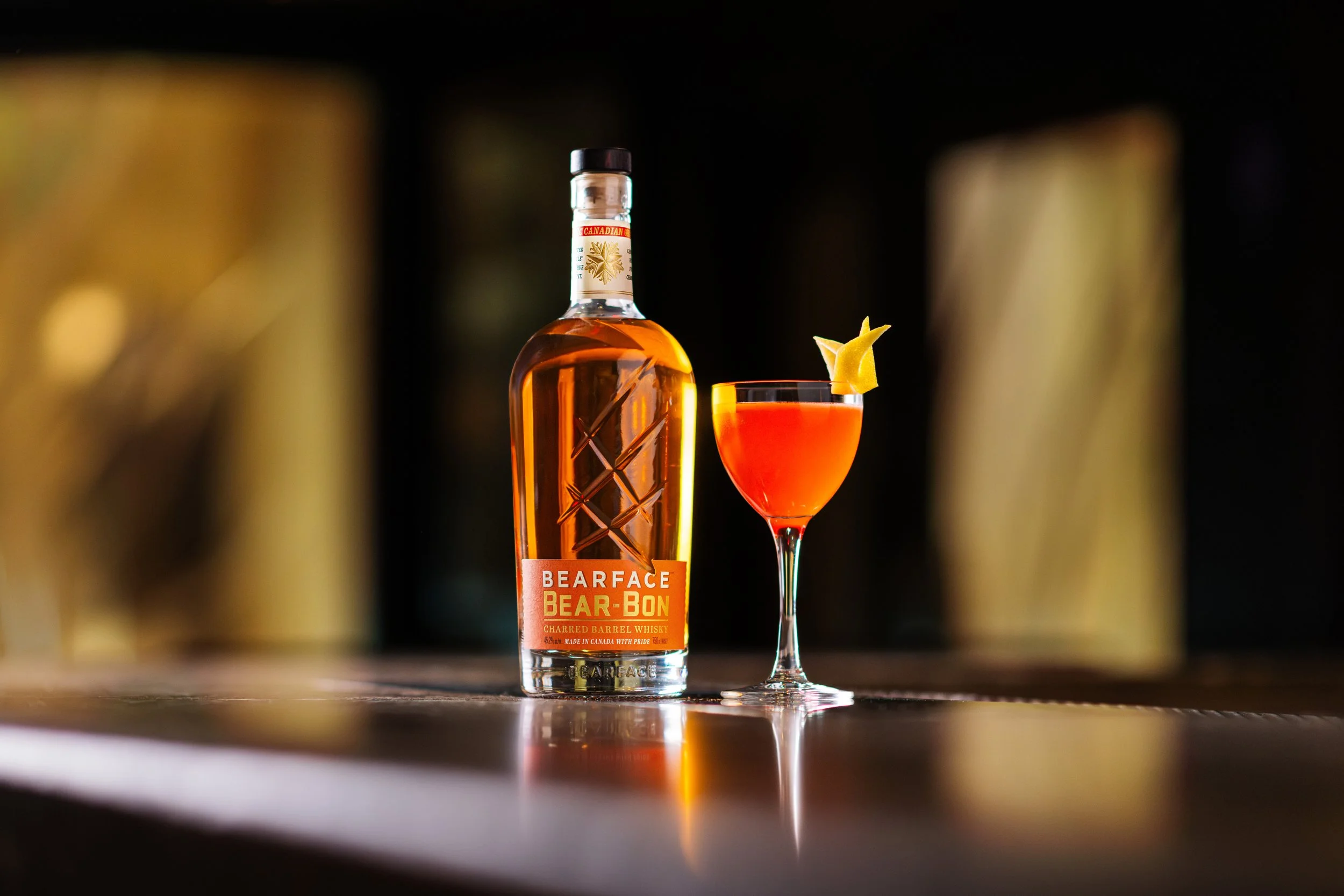
BEAR-BON is built from three individual Canadian single-grain whiskies: approximately 60 per cent corn whisky aged in ex-bourbon barrels (the same corn foundation used in Triple Oak), 35 per cent high-rye blended whisky, and 5 per cent single malt, married and finished for around 18 months in those hand-charred French oak casks. Just 19 casks make up this inaugural release, currently available in BC, and coming soon to Alberta, and Ontario.
Stylistically, Andrés places it somewhere between a wheated bourbon and a more barrel-forward, alligator char-influenced bourbon. There is sweetness and familiarity, but also spice, structure, and a distinct Canadian accent.
“I love the idea of designing a whisky for its flavour profile and incorporating Canadian, American, and unconventional components to create something new but familiar,” he says. “It tastes sort of like a bourbon and has the three main grains like a bourbon, including being predominantly corn based, but it’s also completely different from a bourbon at the same time.”
That difference matters. BEAR-BON is not trying to imitate bourbon. It is not built from a single mash bill, nor matured in brand new charred American oak. Instead, it uses Canada’s blending flexibility to create a Southern-style flavour profile through individual grain whiskies and a uniquely Bearface cask cycle.
Yin and Yang
What makes BEAR-BON more than just a second expression is the way it completes a cycle. The toasted wine casks from the Okanagan first season in BEARFACE Triple Oak. Once used, they are hand-charred and filled with BEAR-BON. When BEAR-BON has run its course, those casks, carrying the memory of wine, whisky, and char, can return to age more corn whisky for Triple Oak, potentially replacing ex-bourbon American oak entirely.
"By linking the process back to BEARFACE Triple Oak, it's all connected and thus it becomes a cycle," he says. One expression uses toasted casks to deliver flavour. The other uses charred casks. One is about oak, one is about grain. Together, they form something greater than either alone — each sustaining the conditions for the other's existence.
It's a relationship that also speaks to how Faustinelli thinks about craft, not as a linear progression from one product to the next, but as an ecosystem where creative constraints become creative fuel and leftover casks don't get sold to France, they become the foundation of something new.
At 45.2 per cent ABV, BEAR-BON carries a little more weight than Triple Oak's 42.5 per cent. Its medium amber hue deepens toward orange; a visual echo of that remarkable cask treatment. It is jazz for whisky lovers: familiar enough to welcome bourbon drinkers, distinct enough to challenge what they thought they knew.
"This is a whisky that can only be made in Canada and it's only possible because of the foundation we built with Elementally Aged® BEARFACE®," Faustinelli says.