solera from the ground up
Born in the bodegas of southern Spain, the solera system transformed aging into an ongoing conversation between past and present. Today, rum and whisky producers are borrowing the same idea, although not always in quite the same way.
We tend to imagine maturation as a tidy one-way trip: liquid enters a cask, time does its work, and a bottle emerges with a reassuring number on the label. Solera does away with that clean beginning and end. Only a portion is drawn off at a time, and every new addition mingles with what remains from earlier cycles. In other words, every release inherits something from those that came before it.
The story begins in the bodegas of Jerez, where Sherry producers developed fractional blending to create continuity across harvests. The system has since travelled into rum, whisky, and other spirits, with producers borrowing the traditional structure, its underlying philosophy or sometimes simply the appealing idea that a vessel should never be completely emptied.
The connection to memory lies in what the system leaves behind. The past is not preserved in a pristine little compartment. It is absorbed into the whole, becoming harder to isolate while continuing to influence what comes next.
a system built for continuity
Although the winemaking history of Jerez stretches back thousands of years, the criaderas and solera system is comparatively recent. It began taking on its recognizable form in southern Spain during the late 18th century, as Sherry producers looked for a way to supply wines with greater consistency.
Until then, wines were more commonly understood through their vintage, or añada. Each harvest stood largely on its own, carrying the particular conditions of that year. That individuality could be fascinating, but it also made reliability difficult. One growing season might produce a generous wine, the next something leaner or less expressive. For bodegas supplying increasingly important export markets, depending entirely on the character of a single harvest was a commercial risk.
Fractional blending offered another way to think about quality. Instead of presenting each vintage separately, producers could gradually integrate new wine into older stocks, absorbing the variations of individual harvests into a recognizable house style.
The goal was not to erase difference completely. Solera shifted the emphasis from vintage to identity. A harvest no longer had to stand alone; it became one voice in a house style built across generations.
how a traditional solera works
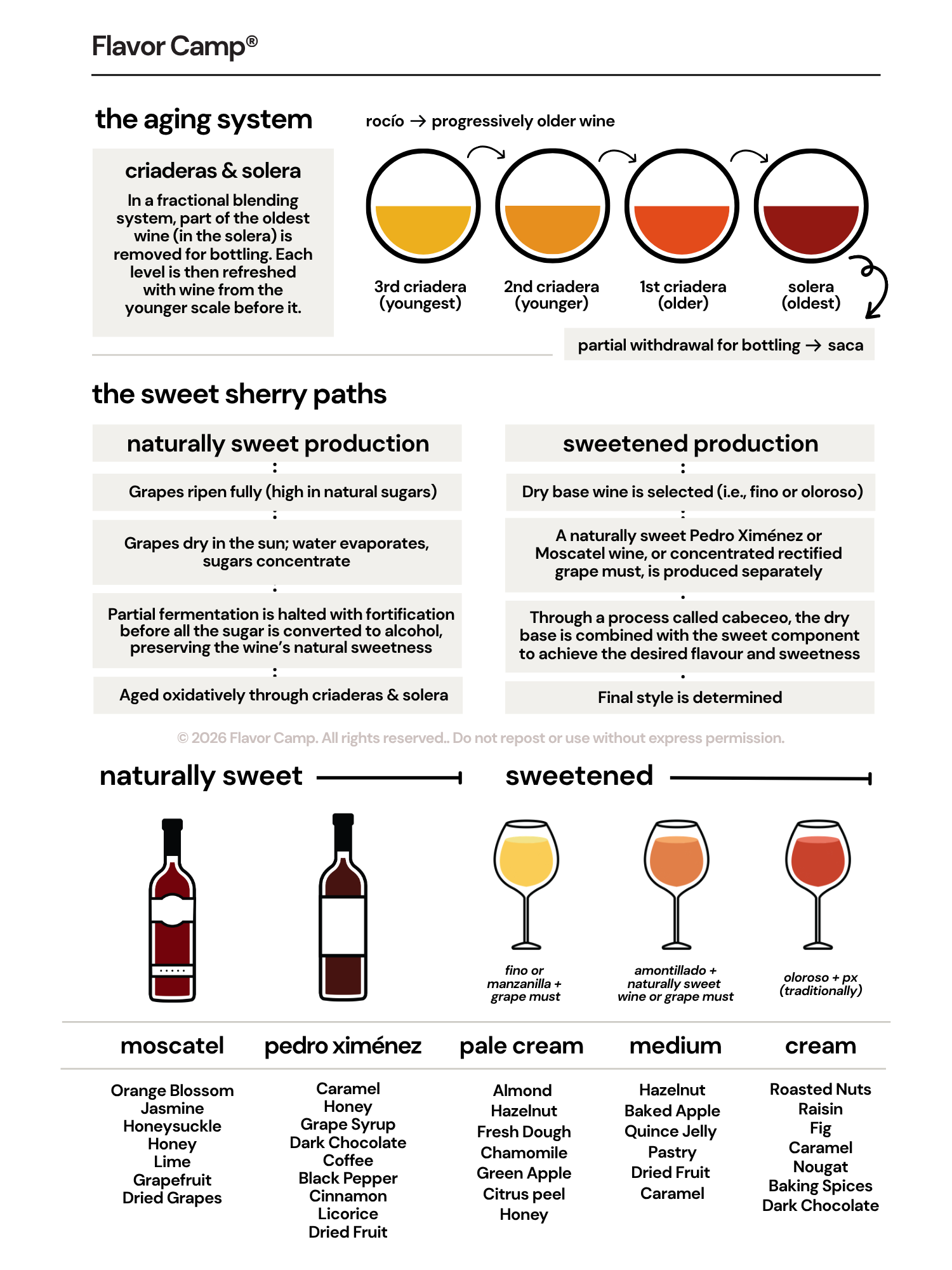
First, an important clarification: the solera is not technically the entire system. It is the final and oldest scale of casks, traditionally positioned closest to the ground, or suelo. The progressively younger scales that feed it are called criaderas, a word derived from criar, meaning to raise or nurture.
When wine is required for bottling, only a portion is removed from the solera. This withdrawal is known as the saca. The space created in those casks is then replenished with wine from the first criadera, the next-youngest scale. This replenishment is called the rocío.
The first criadera is refreshed from the second, the second from the third, and so on, until the youngest scale receives new wine, often following an initial period of static aging known as sobretabla.
The wine moves through the system. The barrels generally do not.
Although soleras are frequently illustrated as pyramids of casks, the levels are defined by the wine’s stage of development rather than the barrels’ physical position. A large solera may be distributed across different parts of a bodega, with dozens or even hundreds of casks belonging to each scale.
The essential point is that no scale is completely emptied. Old wine remains as younger wine enters, and the two gradually become inseparable. With every cycle, the proportion of the original wine becomes smaller, but its influence is carried forward through the blend.
This is also why the founding date of a solera should not be confused with the age of everything inside it. A solera established in the 19th century does not contain casks filled entirely with 19th-century wine. Its contents have been refreshed many times. The date marks the beginning of an ongoing system, not a conventional vintage or age statement.
flavour behind the formula
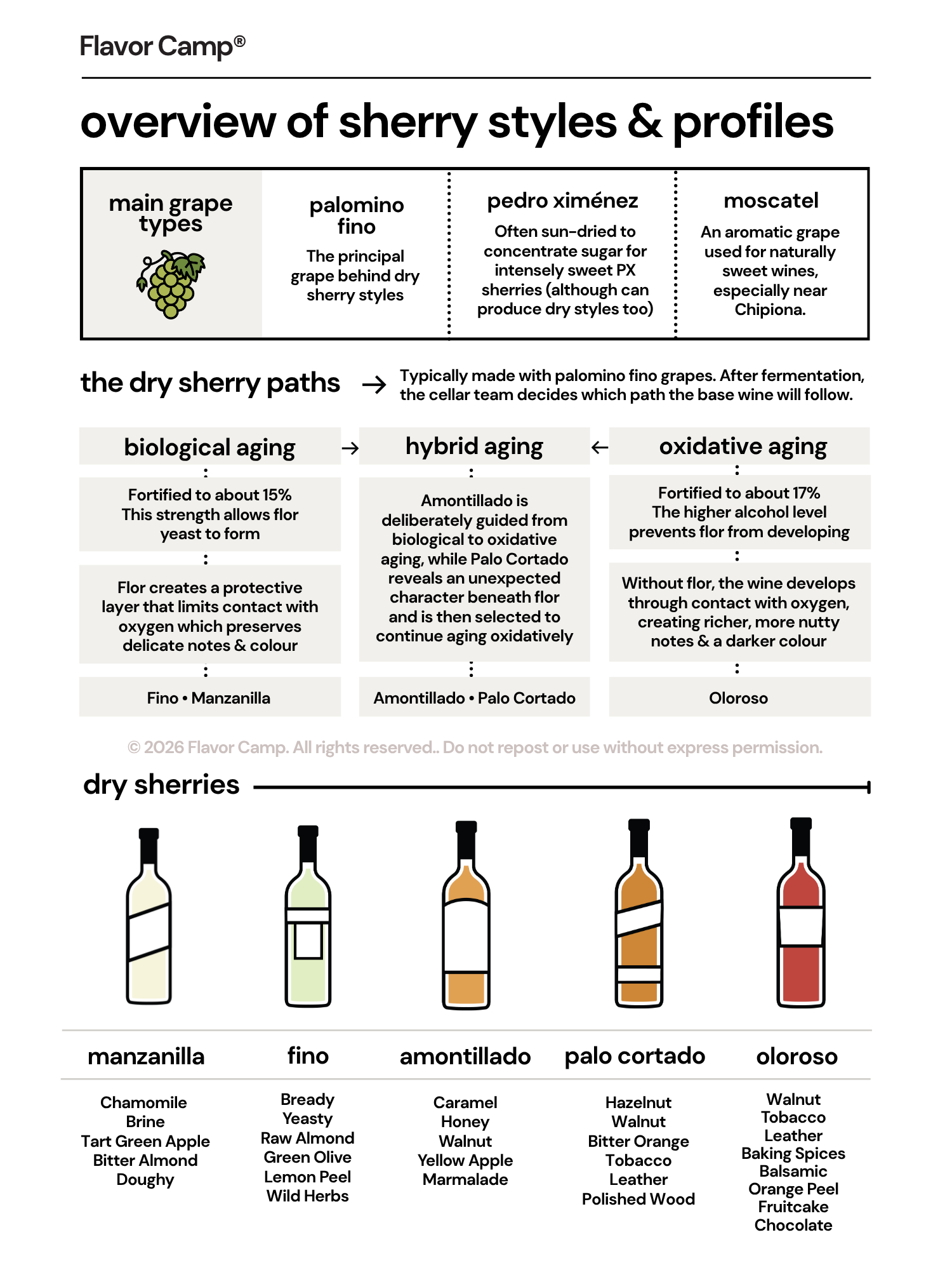
Consistency may have helped inspire the system, but in Sherry production, solera does much more than smooth out the differences between harvests. For biologically aged wines such as Fino and Manzanilla, younger wine supplies nutrients that help sustain the living veil of yeast known as flor. This layer forms across the wine’s surface, protecting it from direct oxidation while contributing the distinctive character associated with biological aging. Regular replenishment helps keep that biological environment active.
For oxidatively aged wines such as Oloroso, the movement between criaderas gradually integrates wines at different stages of development. Younger components bring freshness, while older components contribute concentration and maturity. Amontillado moves through both worlds, beginning under flor before continuing oxidatively.
Pedro Ximénez and Moscatel wines can also be aged through criaderas and solera, as can blended sweet styles such as Cream Sherry.
The system, therefore, does not create one particular flavour. Bone-dry Fino, deeply oxidative Oloroso and intensely sweet Pedro Ximénez can all emerge from versions of the same underlying method. Ultimately, solera is the architecture, not the final taste.
beyond jerez
Jerez may be its most famous home, but the tradition is not confined to Sherry.
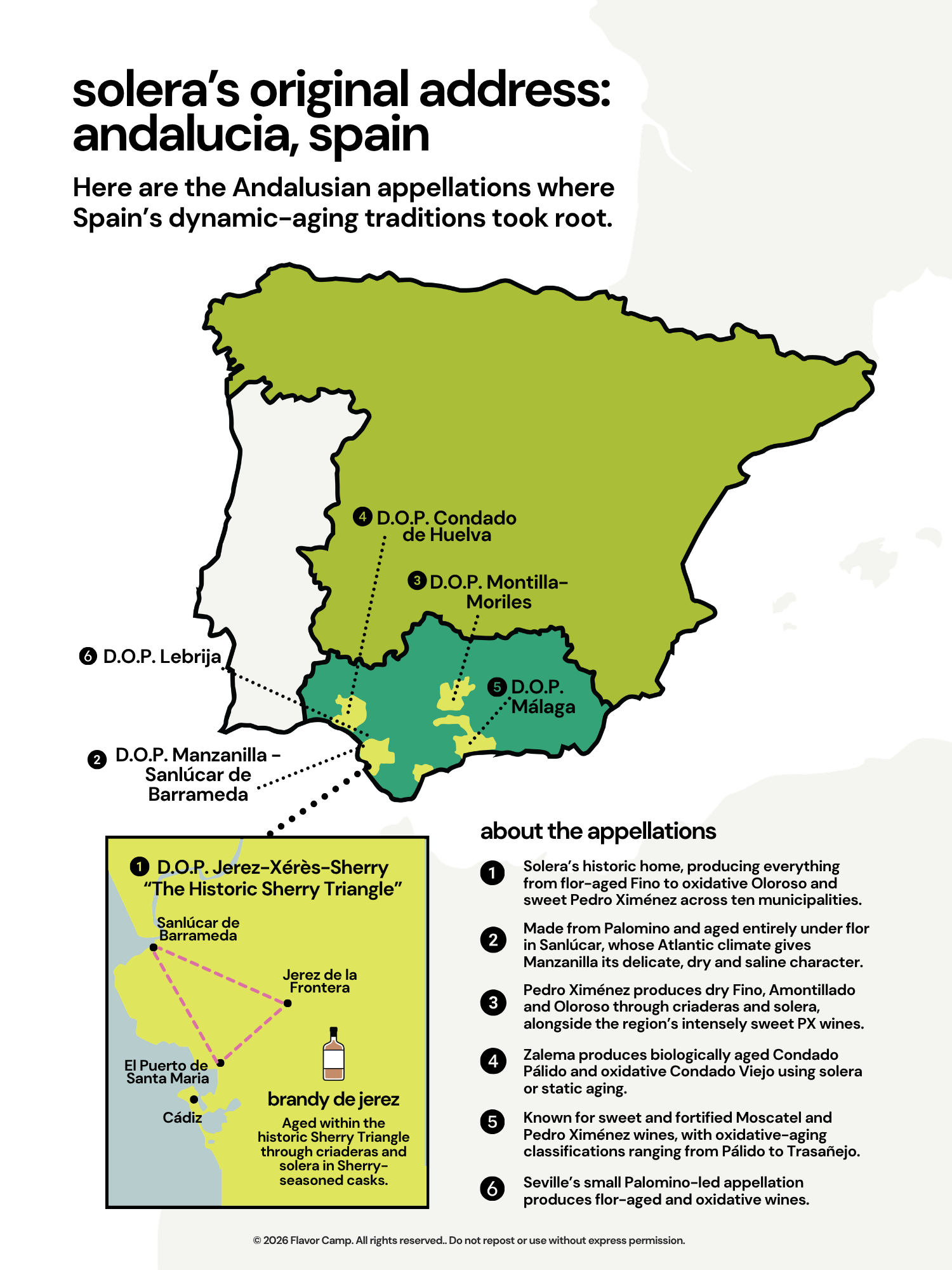
Northeast of Jerez, in the province of Córdoba, Montilla-Moriles uses its own criaderas and soleras for Finos, Amontillados, Olorosos, Palo Cortados and Pedro Ximénez wines. The terminology and aging traditions may look familiar, but Montilla-Moriles is a separate denomination with its own geography, grapes and production identity.
The method also crossed from wine into spirits without travelling very far. Brandy de Jerez is aged within Jerez de la Frontera, Sanlúcar de Barrameda and El Puerto de Santa María, using American oak casks previously seasoned with Sherry. Its criaderas and solera system brings the same gradual movement and integration to grape spirit, demonstrating that the method’s relationship with distillation began in its Andalusian homeland.
From there, however, solera learned to travel much farther.
solera becomes a broader idea
Once solera moved beyond southern Spain, its definition began to stretch. Some producers recreate the traditional cascade, moving liquid fractionally through several levels of casks. Others use a single perpetual vat that is partially emptied and continually replenished. Some mature spirits conventionally first, then use a solera-inspired system for marrying or finishing. Still others apply the term to a sequence of different cask types.
These approaches share a philosophy, but not necessarily an identical structure.
This matters because “solera-aged” can sound like a precise production claim or even an age statement. In reality, it may describe several very different processes. The most useful question is not simply whether a producer uses a solera, but what part of the traditional system it has chosen to preserve.
rum: solera’s eager adopter
Rum has produced some of the clearest adaptations of the Andalusian model.
At Venezuela’s Hacienda Santa Teresa, Santa Teresa 1796 follows a three-stage process. Light, heavy and pot-still rums are first aged separately before being blended. That blend then enters four rows of solera casks, moving downward as each barrel is partially withdrawn and replenished from the row above. The casks have never been fully emptied since the system was filled in 1992. Finally, the rum rests in large, never-empty vats made from French Limousin oak.
The process combines two different solera interpretations: a fractional cascade followed by perpetual vatting. The first resembles the movement of a traditional criaderas and solera system. The second preserves continuity within a single vessel.
Ron Zacapa takes a broader approach. The Guatemalan producer describes its aging as being inspired by Sistema Solera, moving rum through a selection of casks that previously held American whiskey, Oloroso Sherry, Pedro Ximénez wine and, in the case of Zacapa XO, Cognac. Here, the emphasis falls as much on the progression through different cask influences as it does on the blending of ages.
Black Tot Historic Solera creates another direct link back to Jerez. Rums from Guyana, Barbados and Jamaica are blended before further maturation in Pedro Ximénez and Oloroso Sherry casks and what the producer describes as an authentic solera. Sherry enters the process twice: first through the character retained in the seasoned casks, and again through the aging system itself.
Together, the three demonstrate why rum’s use of solera cannot be reduced to one formula. Santa Teresa emphasizes fractional movement. Zacapa emphasizes the journey through multiple cask styles. Black Tot brings Caribbean rum, Sherry-seasoned oak and solera maturation into the same conversation.
What each preserves is the idea that maturity can be accumulated collectively rather than achieved by one parcel of spirit in isolation.
whisky: solera after maturation
In whisky, solera is frequently used less as a complete maturation system and more as a final tool for marrying casks together.
Glenfiddich 15 Year Old is perhaps the best-known example. The whisky first matures for at least 15 years in a combination of American and European oak, with a portion receiving additional time in new American oak. The casks are then brought together in a large oak Solera Vat inspired by the bodegas of Spain.
The vat was first filled in 1998 and has never been completely emptied. Only half of its contents are removed before it is replenished with more 15-year-old whisky. The whisky later rests in marrying tuns before bottling.
This is not a traditional series of criaderas. No younger whisky is gradually passing through multiple scales until it reaches the oldest row. Instead, already mature whisky enters a perpetual marrying vat. Glenfiddich has borrowed the principle of continuity while redesigning the architecture around Scotch whisky production.
On Vancouver Island, Shelter Point Distillery uses a solera-style continuous vatting process for its core Classic Single Malt and Cask Strength Single Malt. Casks with different finishes can be married into an evolving system, helping the distillery maintain a consistent house profile even as the individual barrels available for each release change.
That distinction is useful. At Shelter Point, as at Glenfiddich, solera does not describe every year of the whisky’s maturation. It describes how separately aged casks are brought into relationship with one another.
Blade & Bow takes the idea in another direction. Its core Kentucky Straight Bourbon uses a solera system intended to preserve continuity with some of the oldest whiskey stocks associated with Stitzel-Weller. The evolving solera component is mingled with other matured whiskies, connecting each new release to the stocks that preceded it.
In 2026, the brand extended that approach with Blade & Bow 12-Year-Old Solera Reserve. The bourbon begins with a 12-year age statement before entering a multi-vat finishing and blending system built around Cognac, Bordeaux, Moscatel and Port vats. Each batch builds upon the material retained from earlier batches.
This is a long way from the chalk-white soils and cathedral-like bodegas of Jerez. Yet the central idea remains recognizable: do not empty the past completely. Leave something behind for the next release to inherit.
so, is it really solera?
Calling all of these methods “solera” can be both helpful and confusing. The word gives producers a familiar way to communicate continuity, fractional blending and consistency. It can also flatten important distinctions between a traditional criaderas and solera system, a perpetual vat and a multi-cask finishing program.
Perhaps the fairest way to understand these spirits is not to ask whether they are perfectly faithful copies of Sherry production. Most are not trying to be. Instead, we can ask what they have borrowed.
Is the liquid moving through multiple age levels? Is only part of each vessel withdrawn? Does every batch retain a connection to the one before it? Is solera being used throughout maturation or only during finishing and marrying?
Those questions tell us far more than the word alone.