homesick in the mouth: hacking nostalgic cocktails
When it comes to drink preferences, I land somewhere between a novelty-obsessed psychonaut and an aversion-numb degenerate. I don’t care how funky, conceptually depraved, or downright unholy a drink may be—if it’s new or strange, I want it in my mouth. This places me far outside the mainstream, where most people enjoy cocktails that are balanced and thoughtfully crafted, boasting enticing aromas and textures. These are the folks who keep successful bar programs thriving. I am the reason some bartender, somewhere, is infusing Malört with ghost peppers.
But there is one elixir from the mixologist’s cabinet powerful enough to temporarily slake my craving for Parmesan Espresso Martinis and Industry Sours: a cocktail served with a rich and heady wash of nostalgia.
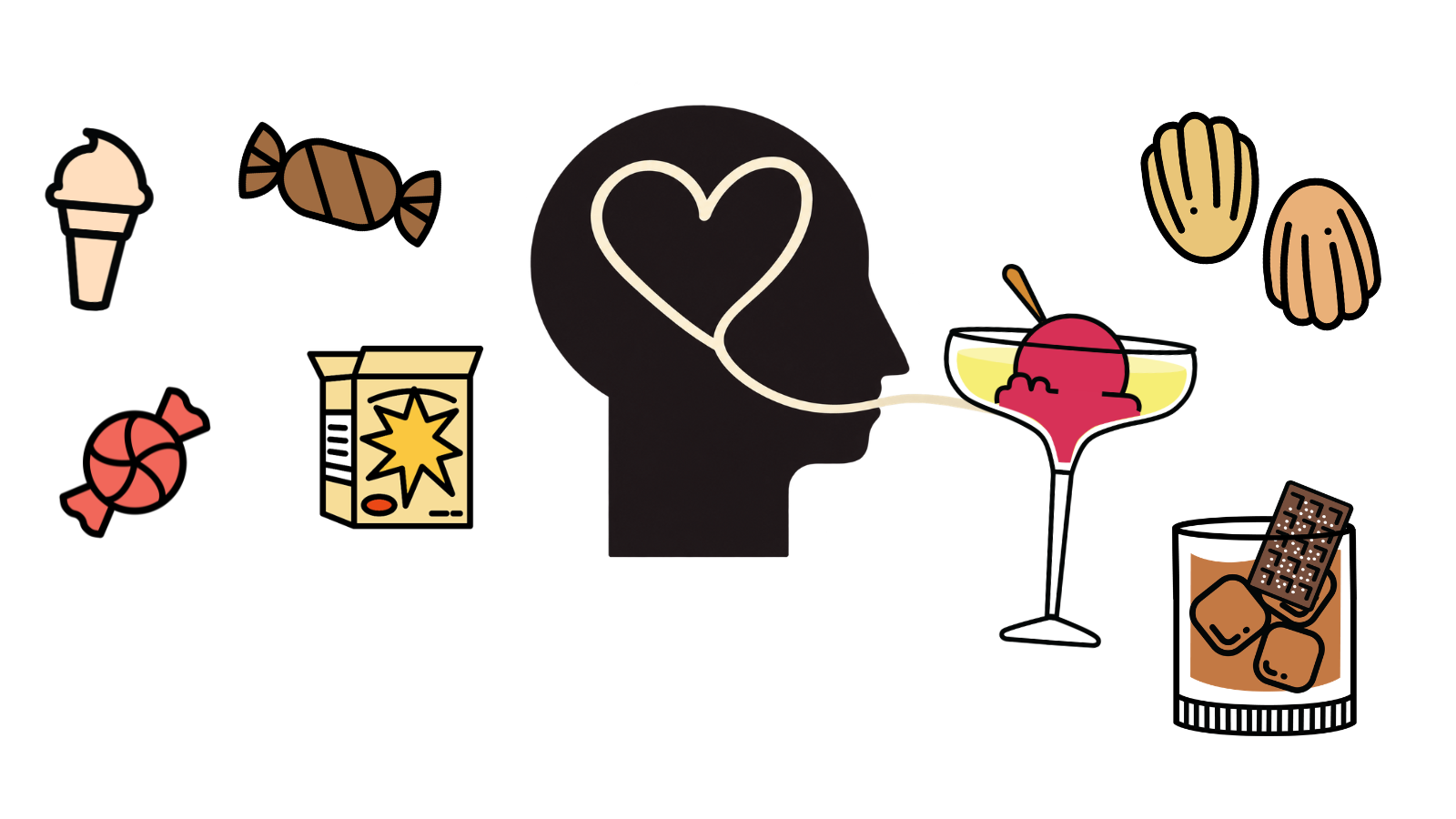
I’m talking about the kind of beverage that, at its most powerful, can briefly collapse time and space, enveloping your past and present selves in the sensory comforts of a simpler time. Drinks like these are rare, and any bartender hoping to craft a cocktail that guests savour with closed eyes and dreamy smiles should first understand what this emotion truly means and how it unfolds in the brain.
beyond the madeleine effect
The word nostalgia is constructed from the Greek words nostos (“homecoming”) and algos (“pain or distress”) and was coined in the 17th century to describe a suite of depressive symptoms that accompanied acute homesickness. But by the early 20th century, the valence of the term had shifted dramatically, taking on its modern definition: “a wistful yearning for the past.” These two slightly different scans of homesickness across space and time reveal the essential qualities of a properly nostalgic flavour experience. First, it should make you feel “at home,” which is to say safe, nourished, and content. Second, it should evoke positive, vivid memories that manifest as mental and emotional time travel.
Proust’s famous madeleine scene offers perhaps the best-known illustration of sensory time travel. In his novel, In Search of Lost Time, the narrator dips a madeleine into tea. As the flavour reaches his palate, he is flooded with memories of childhood Sundays in Combray, where his aunt served him the same treat. The scene gave its name to the “Madeleine effect,” a sudden rush of autobiographical memory triggered by a familiar sensory cue.
What Proust’s narrator experienced was not taste alone, but flavour: the combined impression of what landed on his tongue and the aromas released as he ate. The madeleine has since become shorthand for flavour’s power to retrieve the past, but its two component senses do not reach the brain by the same route. The reason for that split is buried deep in our evolutionary wiring. To exploit it for nostalgic purposes, it pays to become familiar with a curious quirk of the animal brain known as “thalamic bypass.”
two senses diverged
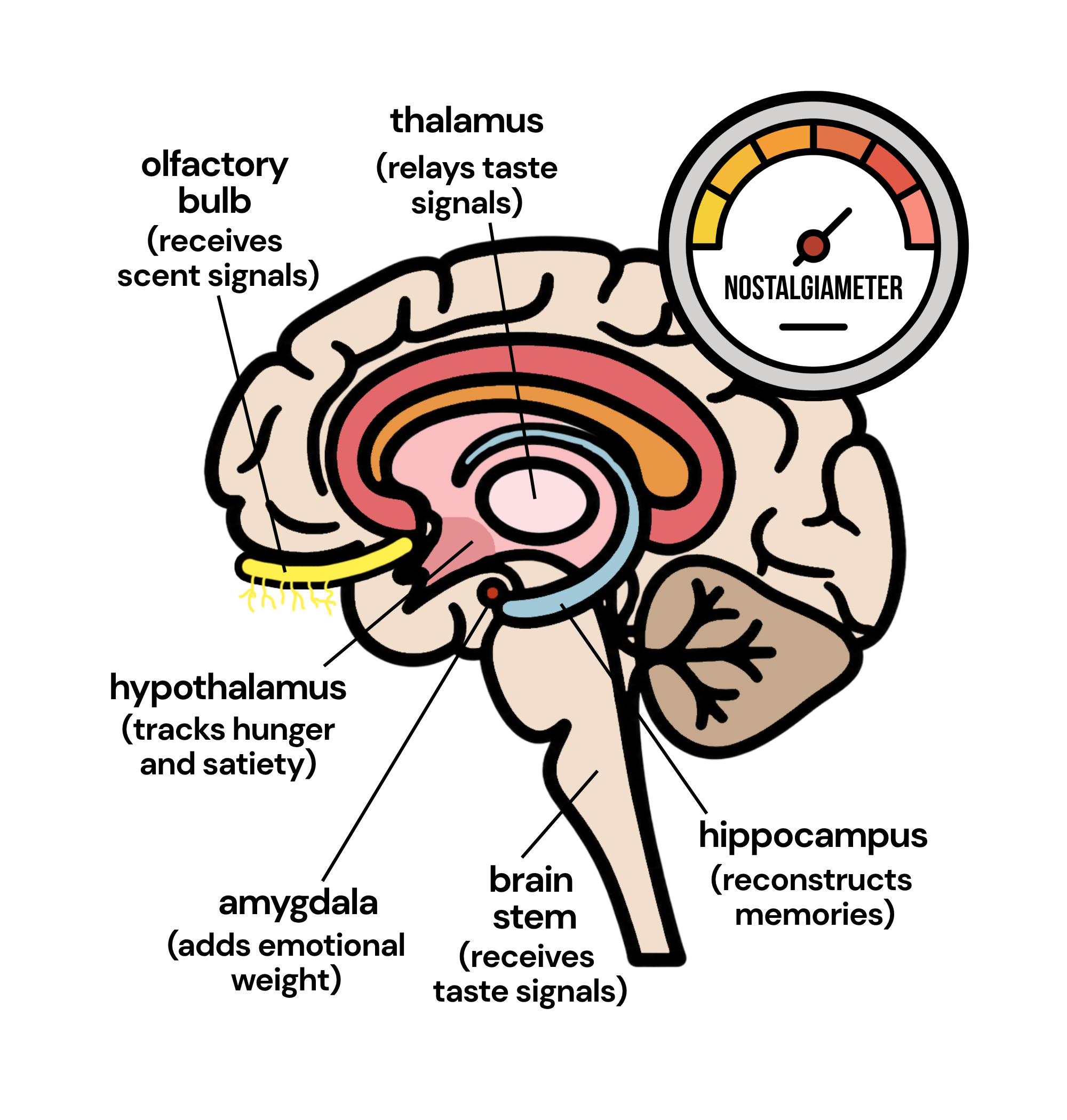
Back in the day (a couple billion years ago), smell and taste were part of a single sensory system known as chemotaxis, which allowed single-celled organisms to detect chemical gradients in water that signaled either food or danger. As organisms became more complex, the senses diverged and specialized. Taste came to evaluate dense, immediate stimuli entering the body, while olfaction evolved to detect trace particles carrying broader information about the surrounding environment.
As animal brains became larger and more elaborate, the two pathways developed differently. Taste information was routed through the brain stem and then to the thalamus, which acts as a gatekeeper for attention. Functionally speaking, this means that a taste signal must be processed and integrated with other sensory information before the brain determines whether it deserves our attention. Smell followed a more direct route, initially bypassing the thalamus and activating regions involved in memory, emotion and spatial mapping. This is why aromas can capture our attention immediately, reflexively, and without conscious processing. This “thalamic bypass” helps explain why the senses play such different roles in flavour. Taste keeps watch over the body you inhabit now, evaluating what enters it for nourishment or danger. Aroma signals, on the other hand, are descriptive of the environment beyond the body’s physical boundaries. Aromas elicit immediate and almost automatic attention, prompting the brain to compare the present against a lifetime of people, places, and experiences and ask: Have I been here before?
a welcome glimpse of home
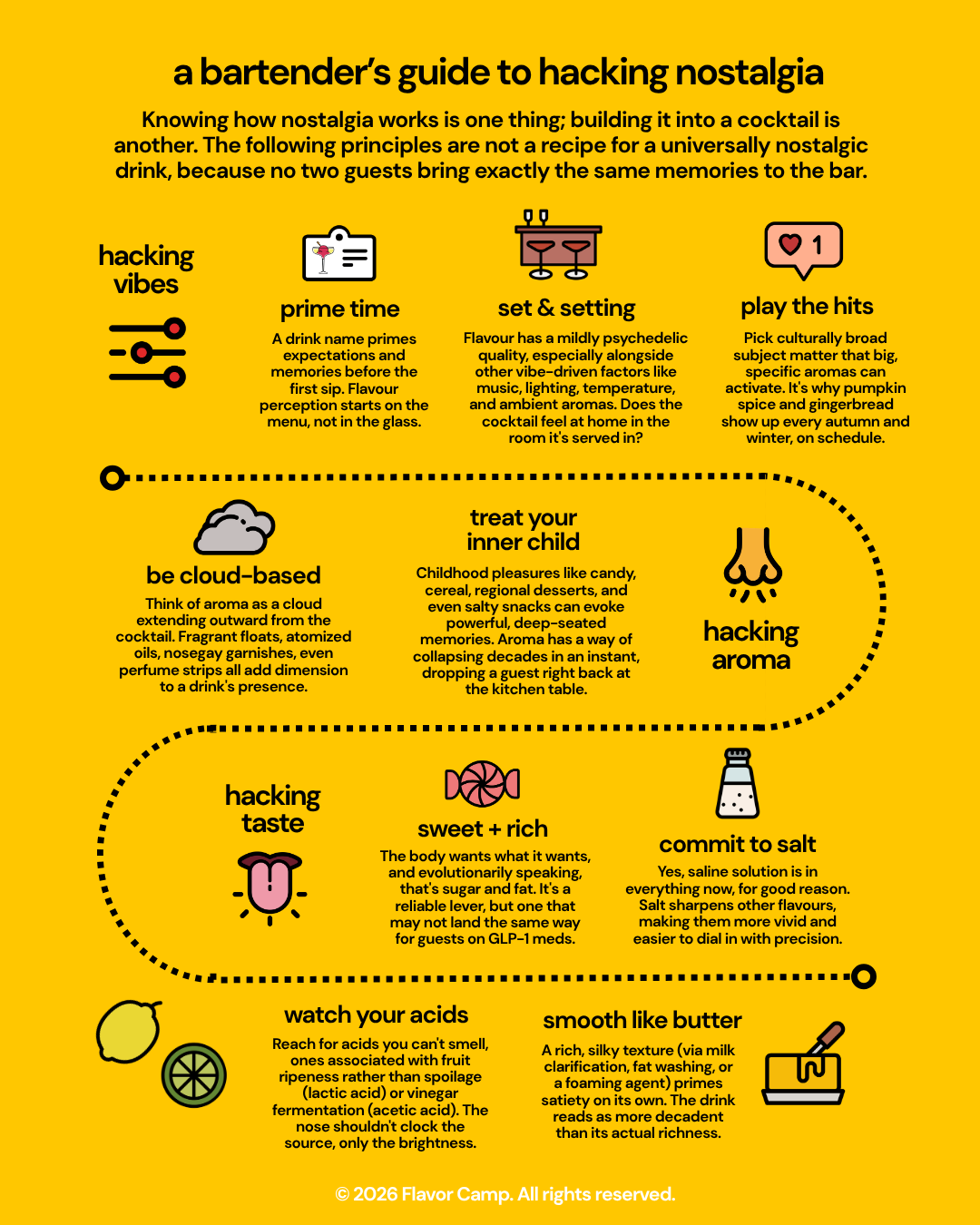
For bartenders, this division of sensory labour is essential to hacking nostalgia. Easygoing tastes and textures create comfort in the present, signalling to the thalamus that “it’s all good here,” and leaving your attention free to be swept off by potent, specific aroma cues that trigger autobiographical memories. A nostalgic cocktail needs to engage both the taste and aroma pathways in this specific manner if it hopes to register on the nostalgiameter. And that’s because, like flavour, nostalgia is a bit of a paradox.
Flavour seems like a single, straightforward sense that happens in your mouth, until you realize it’s actually many pathways and brain regions firing simultaneously. Taste and smell seem to make roughly comparable contributions to flavour until you learn that they serve different evolutionary purposes and engage the brain in radically different ways. And the past seems to live solely in history books, that is until the first sip of a sage-infused Manhattan catapults you across thousands of miles and several decades in a single instant. In all these cases, the unexpected has a way of sneaking in to surprise us.
Maybe, in the end, this is what draws me to a nostalgic cocktail. It doesn’t lean on novelty or cheap dopamine tricks to attract and hold my already frayed attention. It’s not seducing me with caviar, showing off its new rotavap, or challenging my guts to a fist fight (like that ghost pepper-infused Malört undoubtedly would). A nostalgic drink very simply acknowledges that we are all complex, layered creatures desperately trying to keep it together as we hurtle through time and space. Then, it executes a couple of deft chemical manoeuvres that allow a little of the past to seep into the present, offering the weary traveler a welcome glimpse of home.
Call it “neuroscience,” or “bartender alchemy,” or “sensory paradox” if you like. I simply call it “magic.”