the past is on the menu
Some bars preserve history through photographs, memorabilia, or dusty bottles hidden on a shelf. Others invite you to taste it. From Montreal to Georgetown to Grand Cayman, these bars are drawing inspiration from the past, collecting vintage spirits not just as curiosities but as ingredients rich with stories to share.
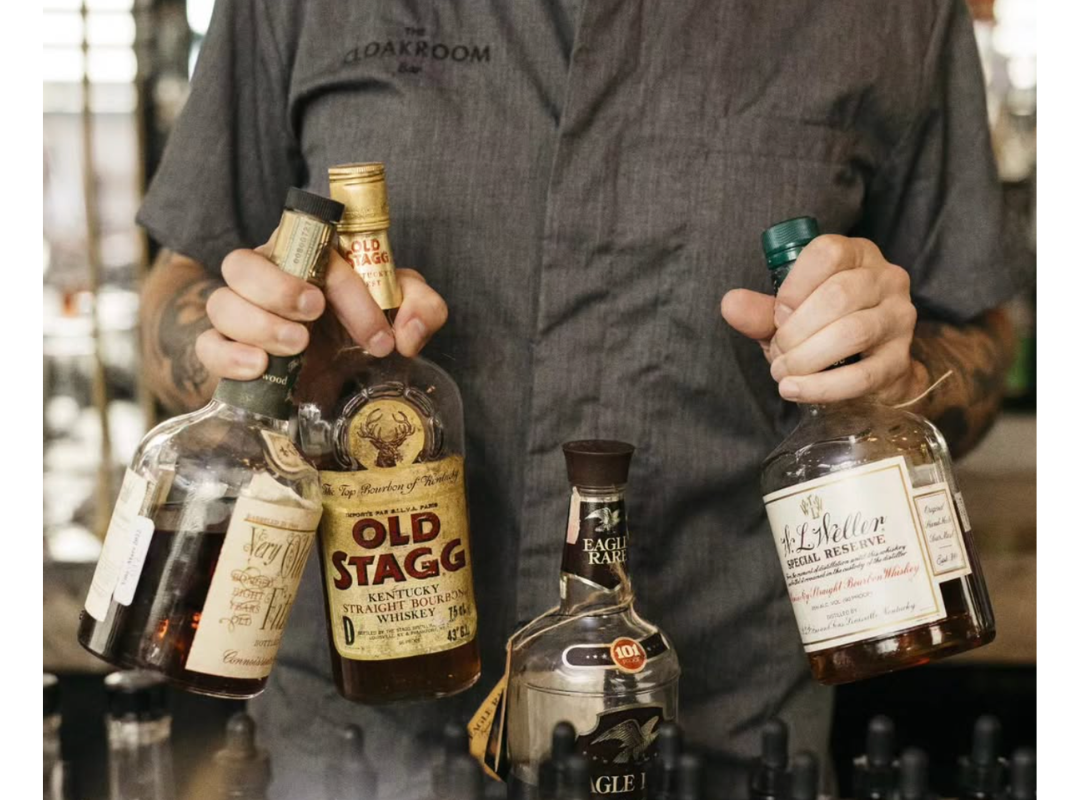
Image: Bartender holds a selection of vintage spirits available at the Cloakroom Bar. Photo courtesy of the Cloakroom Bar.
the cloakroom bar
montreal, quebec, canada
For most bars, the back bar is simply a showcase for available drinks. At Montreal’s The Cloakroom Bar, however, it functions as a living archive.
When owner Andrew Whibley opened The Cloakroom Bar in 2015, amassing one of Canada’s largest vintage spirit collections was never his intention. Instead, he aimed
to introduce Montreal to a style of cocktail bar he’d encountered during his travels and thought the city was missing at the time.
“I wanted to bring elements of bars that I’d experienced outside of Montreal to Montreal,” he says.
The original concept was intentionally minimalist. There was no cocktail menu; bartenders relied on their expertise and the back bar, crafting classic drinks and introducing guests to unfamiliar spirits.
This approach also countered the prevailing cocktail culture. While many Montreal bars favoured syrups, purées, and elaborate preparations, The Cloakroom opted for simplicity, focusing on spirits, amaros, and house-made tinctures.
Then came a trip to Chicago.
A year or two after opening, he visited the Milk Room–a tiny bar inside the Chicago Athletic Association Hotel renowned for its vintage spirit collection. It was the first time he’d seen a bar actively sourcing and serving bottles from decades past.
“I was like, ‘Oh, that would be a cool element to add to our existing program.’”
So he started looking.
Today, The Cloakroom Bar boasts over 200 vintage bottles, some dating to the 1950s and ’60s. The collection began with amaros, relatively accessible and inexpensive at the time, then expanded to bourbon, Scotch, and other spirits.
Tracking these bottles down requires equal parts detective work and persistence. Some arrive via private collectors and auctions. At one point, the bar even advertised on an Italian-language radio program in Montreal, hoping to reach people with forgotten bottles gathering dust in their family liquor cabinets.
“There was a bunch of stuff literally from people’s liquor cabinets,” he says. “Everyone’s Nonna or whatever would have old Campari or whatever it is.”
But the appeal of vintage spirits goes well beyond rarity. Old bottles can taste dramatically different from their modern counterparts.
Amaros and vermouths can continue to evolve in the bottle, sometimes dramatically. Other differences arise from changes in recipes, ingredients, and production methods. Whiskey offers a particularly fascinating example: older bourbons often had different proofs and age statements, and distilleries, equipment, grains, and even barrel wood have changed over time.
“The way old wood interacts with the spirit is completely different,” he says.
A vintage bottle, then, isn’t just an older version of today’s product; it can embody an entirely different era.
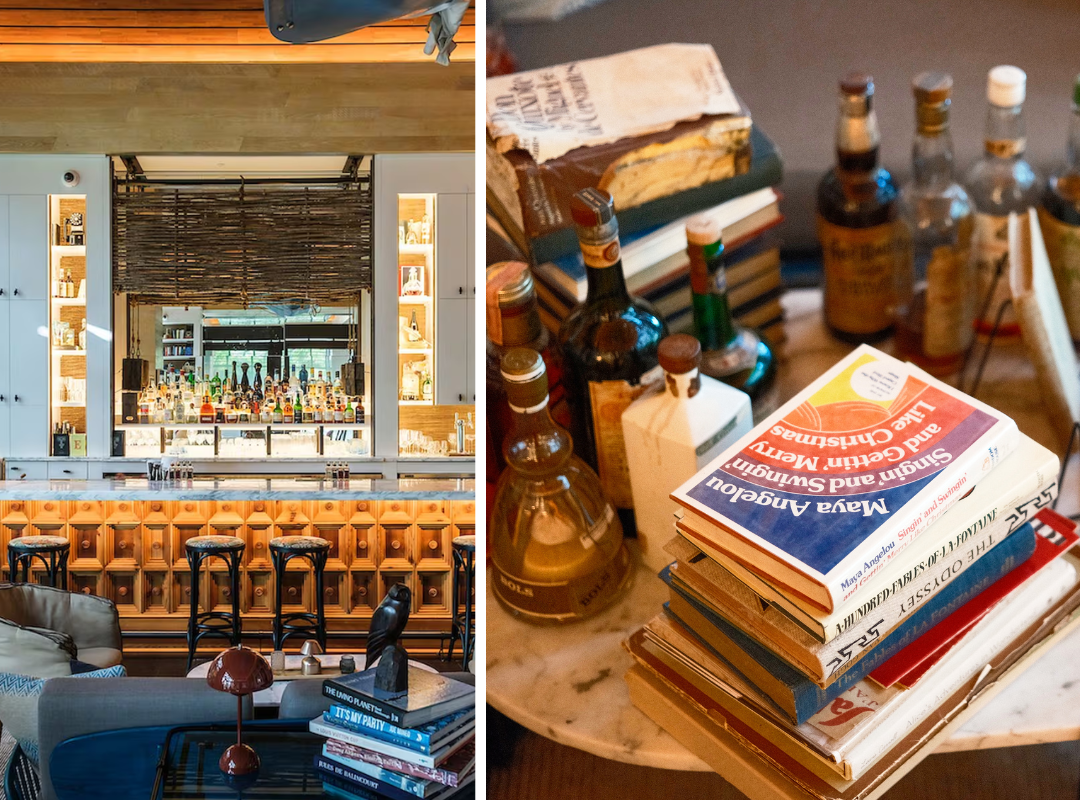
The bar at Library By The Sea its collection of rare and vintage spirits. Images courtesy of Library By the Sea.
library by the sea
grand cayman, cayman islands
Launched in mid-2023 by former London bartenders Jim Wrigley and Andrew Copsey, Library By The Sea is nestled within the Seafire Resort in Grand Cayman and began with a simple yet inspired idea. The hotel lobby already had beautiful seating, local design touches, and, perhaps most notably, an abundance of books. Instead of relegating these books to mere decoration, the duo made them integral to the guest experience, curating a collection of drinks and spirits inspired by literature.
The result is a cocktail bar centred on vintage spirits and drinks that pay homage to classic literature. Some cocktails even receive their own “cover art” on the menu.
For instance, “Please Look After this Drink,” crafted with Barsol pisco, passion fruit beermouth, tropical marmalade, and brioche cream, takes inspiration from Michael Bond’s A Bear Called Paddington. Meanwhile, the “Firm Encouragement,” with Uncle Nearest 1856 whiskey, 1981 tropical IPA vermouth, pineapple, molasses, and smoked paprika, draws from John Grisham’s The Firm.
Most library collections are full of new and old books, but some house rare books revered for withstanding the ages. Library By The Sea took the same approach, creating one of the most robust collections of rare vintage spirits.
The bar’s offerings include—just to name a few—Calvados from the 1980s, a James Hawker's Plymouth Sloe Gin from 1960, liqueurs dating back to the 1930s, and an exceptionally rare Maison Rouge Dinard Grand Reserve Cognac from 1840, priced at $990. The extensive list offers pours ranging from $30 to nearly $1,000, catering to both the curious and the connoisseur.
Guests can savour these rare spirits neat or experience them as part of a bespoke cocktail, offering a literal taste of history with every sip.
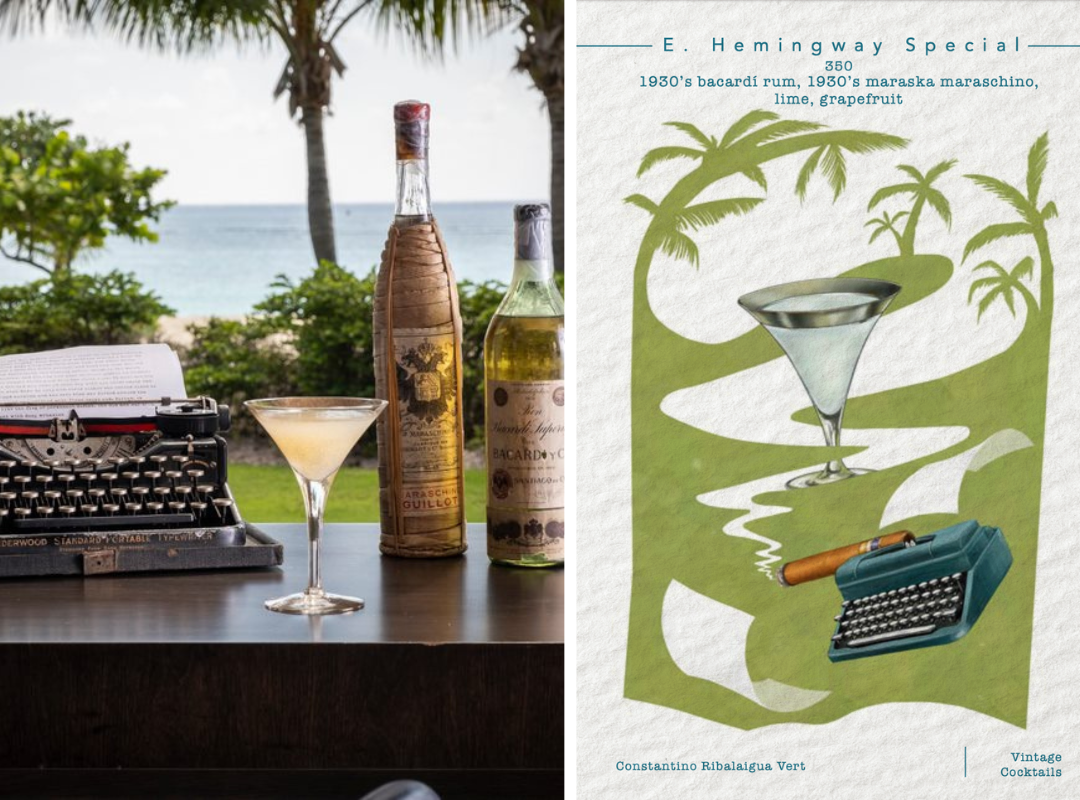
The E. Hemingway Special alongside its 1930s components and the menu listing. Images courtesy of Library By the Sea.
Take the $350 E. Hemingway Special, a variation on the Daiquiri inspired by Ernest Hemingway. This cocktail combines fresh lime and grapefruit juice with maraschino liqueur and Bacardi Rum, both sourced from the 1930s, capturing the flavours of a bygone era.
The maraschino cherries of the 1930s were grown in a different place, and Wrigley has been quoted as saying that today's maraschino is not as bright or fresh as yesteryear's. The same thinking extends to the rum. The bar uses vintage rum because Bacardi, like many spirits brands, is no longer produced in the same place or in quite the same way it was when Hemingway was drinking his Daiquiris.
In that sense, the bar’s vintage collection isn’t about drinking old spirits. It’s about drinking history, and discovering how much a cocktail’s character changes when its ingredients travel through time.
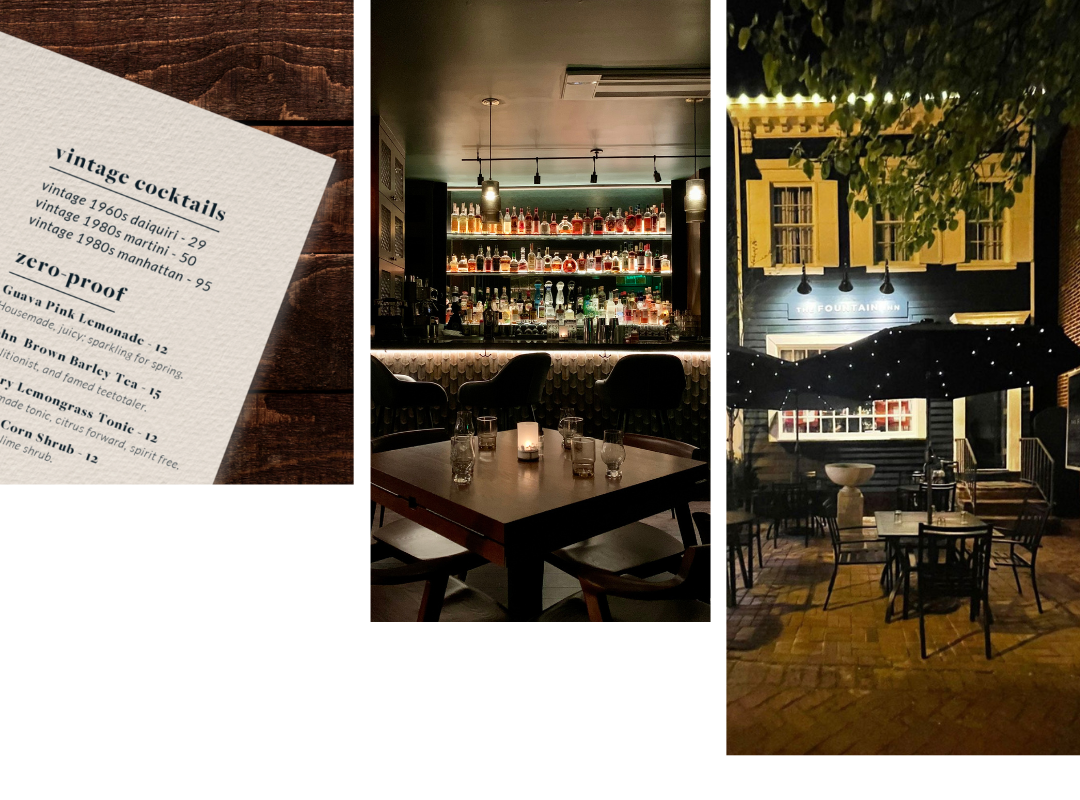
the fountain inn
washington, dc, usa
In Georgetown, history is never far from sight. It’s woven into the streets, echoed in the architecture, and alive in the stories behind its buildings. At The Fountain Inn, history even infuses the bar itself.
Legend has it that The Fountain Inn was a favourite haunt of George Washington, who, according to historical accounts, both slept and supped there. Thomas Jefferson even praised the inn’s keeper, declaring that no one on this side of the Atlantic poured a better bottle of Madeira than “old Suter.” Its original location in Georgetown is unknown, but when the team behind the current Fountain Inn opened its new location in 2022, they infused it with the spirit of the past, while keeping up with modern tastes.
“We wanted to take that idea and not be old in our ways about it,” says Charlie Berkinshaw, one of The Fountain Inn partners. Instead, the goal was to draw inspiration from history and give it a contemporary point of view, reinterpreting old drinks, techniques and ingredients in ways that feel relevant today.
That philosophy is perhaps best expressed through the Syllabub, a cocktail that has been on the menu since the restaurant opened. Inspired by a 16th-century drink combining cream, lemon, sugar, wine and sherry, the Fountain Inn’s version is considerably more polished: a beer-based drink topped with white-wine foam and Averna.
“At the end of the day, people don’t just like things exactly the way they were before,” Berkinshaw says. The challenge is to give historical ideas a new spin so they remain interesting and accessible.
This philosophy also shapes the bar’s collection of vintage spirits.
A vintage Negroni, for instance, is crafted with gin, Campari, and sweet vermouth bottled in the 1970s, ’80s, or even earlier, letting guests sample a cocktail much like the one their parents or grandparents might have enjoyed.
The collection boasts an impressive range of vintage amari, some dating back over 60 years. These rare pours don’t come cheap—sourcing decades-old spirits is a feat in itself—but their scarcity is part of the allure. According to Berkinshaw, older amari often reveal richer, earthier flavours, offering a window into how spirits and tastes have changed over time.
For guests, the collection is an open invitation to experiment. Someone born in the 1970s or ’80s might choose a cocktail mixed with spirits from their own birth decade, or compare historic bottles with modern versions. In this way, history becomes something you can taste—not just read about.