
are you tasting the rum, or the story?
Long before you form an opinion about a drink, its description may already be forming one for you.
If flavour is memory, it is also expectation. Before we take a sip, the story surrounding a spirit has already begun shaping the experience.
Imagine being handed a glass of rum and told to expect orange zest, pepper and coffee. Now imagine the same glass introduced as a small-batch rum matured for up to 18 years in bourbon barrels and finished in sherry casks. Finally, imagine being told it was made for long evenings, classic cocktails and slow sipping over ice. The liquid has not changed. But has the taste? Has the value? Has your willingness to buy it?
That was the premise behind a product-blind sensory perception study we recently conducted with participants across Canada. The results suggest that marketing does more than describe the drink. It can direct what we notice, help construct a sense of premium value, and shape the story we carry away from the glass.
one rum, three descriptions
Every participant tasted the same commercially available aged rum, retailing for roughly $65 CAD. The specific bottle is intentionally unnamed here because the study was designed to examine framing, not the reputation or baggage of the brand itself.
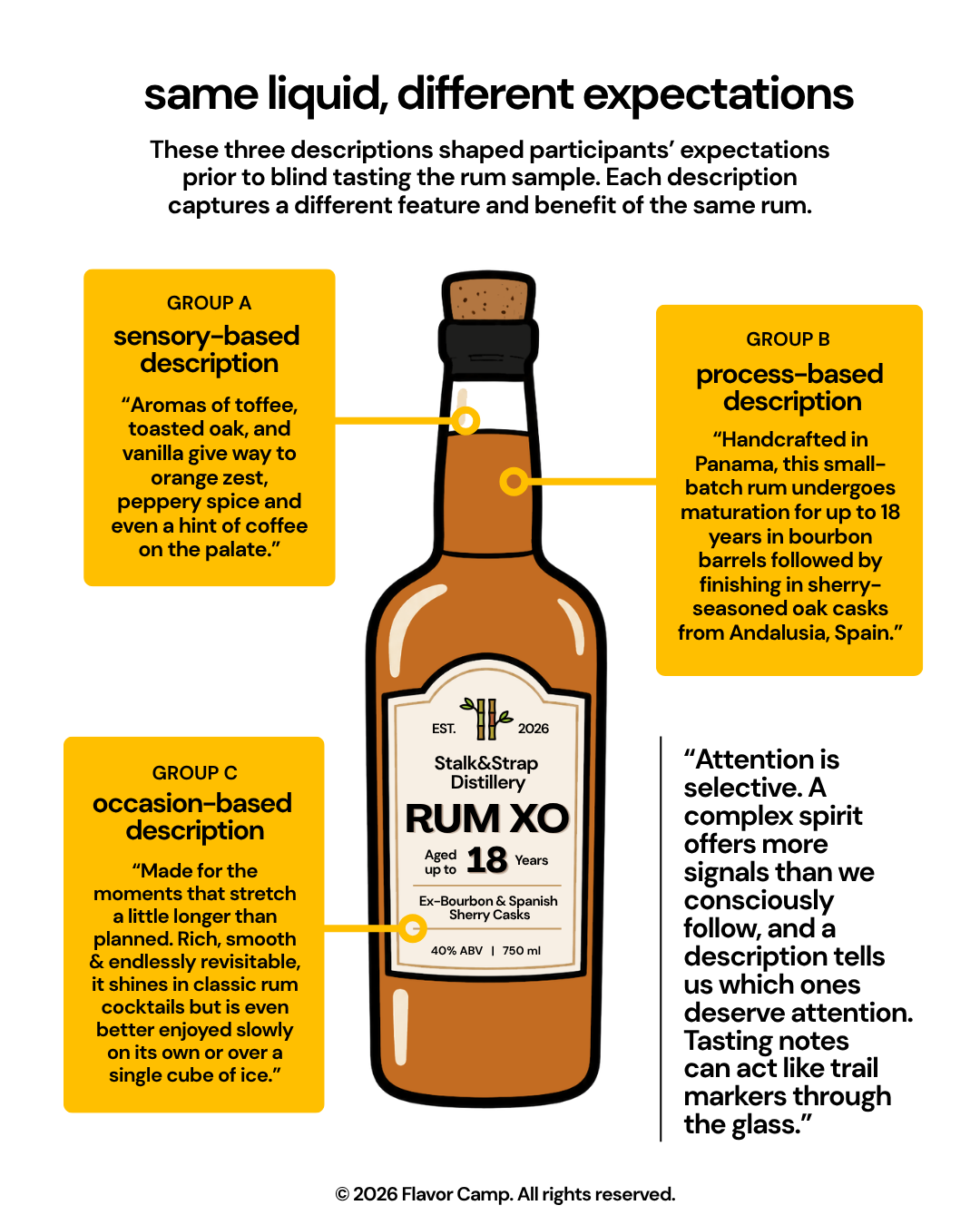
Group A read a sensory description naming toffee, toasted oak, vanilla, orange zest, peppery spice and coffee. Group B received production details about provenance, small-batch production, bourbon-barrel maturation of up to 18 years and a sherry-cask finish. Group C read an occasion-led description positioning the rum as rich, smooth, revisitable and made for cocktails or leisurely sipping.
Before tasting, participants rated how the rum sounded. Afterward, they recorded what they tasted, whether it met expectations, what it should cost and whether they would buy it. With 113 participants, the findings are directional rather than absolute. They are best read as signals worth testing further.
the flavours we are told to find
The clearest influence appeared in the tasting notes. Forty-nine per cent of Group A repeated orange, citrus, coffee or mocha in their own descriptions. Among participants who had not been given those sensory cues, only 11 per cent used the same language.
This does not necessarily mean anyone imagined flavours that were not there. Attention is selective. A complex spirit offers more signals than we consciously follow, and a description tells us which ones deserve attention. Tasting notes can act like trail markers through the glass.
For brands, accurate specificity can help drinkers recognize and articulate flavour. For consumers, it is a reminder that finding the exact note printed on a label is not always independent confirmation. Sometimes you found it because someone showed you where to look.
how a premium story becomes a premium price
The production description performed a different trick. That group placed the rum's expected price at an average of $65.70, almost exactly its retail price. The sensory and occasion groups valued the same liquid closer to $56 and $57. Twenty-nine per cent of the process group placed it at $75 or more, compared with 11 per cent of the sensory group and eight per cent of the occasion group.
Purchase intent followed a similar pattern. Sixty-one per cent of the process group said they would buy the rum, compared with 43 per cent and 35 per cent in the other groups. Again, this is a directional finding, not proof that production copy will always produce a sale. But it shows how provenance, age and cask language can give a premium price a reason to exist.
For brands, production details can substantiate value when they are specific and meaningful. For shoppers, they deserve a second look rather than automatic reverence. 'Small batch,' 'finished in' and 'up to 18 years' signal premium positioning, but do not reveal the batch size, finish length or age of every drop. Separating fact from the prestige surrounding it is part of becoming a savvier buyer.
the easiest promise sold the least
The occasion-led description was the easiest promise for the rum to fulfil. Seventy-one per cent said it tasted as expected, the highest result of the three groups. Yet only 35 per cent said they would buy it, the lowest purchase intent in the study.
Broad language about slow sipping and long evenings gives us a scene into which we can pour our own memories. It feels familiar because we help complete the picture. But if almost any pleasant rum can occupy that scene, it provides little reason to choose this particular bottle.
Occasion language can create emotional relevance, but it works best after a product has earned a distinctive identity. A mood may make a bottle feel like it belongs in your life. It may not explain why it belongs in your cart.
taste first, read second
Marketing mattered, but the liquid still had the final word. Participants who would buy the rum rated it an average of 7.67 out of nine. Those who would not buy it averaged 4.50. A story can direct attention, support value and reduce hesitation. It cannot rescue a drink someone does not enjoy.
Trusting your gut does not mean dismissing production facts or tasting notes. It means giving your own response the first word. Taste before reading when you can. Write down two or three flavours before checking the label. Notice which styles, casks, raw materials and strengths repeatedly appeal to you. Over time, those patterns become more useful than any single premium cue.
For brands, the strongest story is layered and honest: sensory language to guide attention, production information to support value and occasion language to help consumers imagine a place for the product. None should promise more than the liquid can deliver.
For consumers, the best defence is not cynicism. It is flavour fluency. The goal is not to become immune to storytelling, but to know when you are tasting the rum, when you are tasting the story and when the two genuinely agree.