
Putting the Stamp in Stampede: Alberta Unveils Its Official Whisky Logo
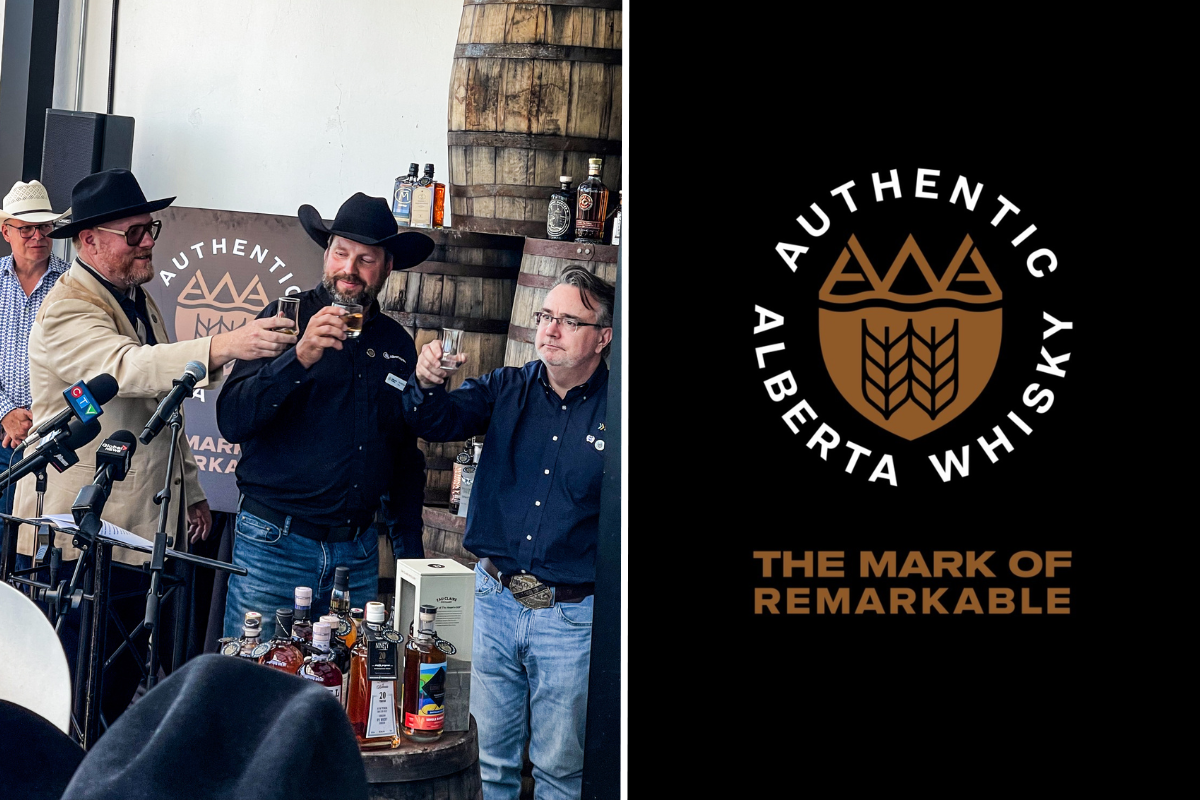
Left: Bryce Parsons, Dale Nally, and Scott Jespersen raise a glass after unveiling the Alberta Whisky logo.
This Stampede, Alberta didn't just pour whisky. It legislated it. On July 6, 2026, five voices took the microphone under the black steel pergola of True Wild Distillery's covered patio in Calgary. String lights hung overhead; the usual seating had been cleared to make room for a standing crowd. What they announced was a first for Canada: a legal definition, and a logo, behind the words "Alberta Whisky." True Wild hosted, but the room belonged to the whole province, a tasting table and bars stocked with bottles from distilleries across Alberta and a crowd thick with the owners who made them.
Bill 24, the Alberta Whisky Act, was introduced on March 31, 2026 and came into force on May 22. It is a short piece of legislation with a long ambition. As of that date, any product labelled "Alberta Whisky" must meet the existing federal standard for Canadian whisky under the Food and Drug Regulations, be produced entirely within Alberta, draw at least two-thirds of the cereal grain used in its mash from Alberta-grown grain, and use water sourced from within the province. Post-distillation, the rules are just as exacting: a distiller can blend in flavouring aged a minimum of two years, add Alberta water to bring the spirit to proof, or add plain caramel, and nothing else. The AGLC is responsible for enforcing all of it. Participation is voluntary. But once a distiller opts in, the logo, a shield stamped with grain, water and prairie horizon, becomes a promise a bottle makes before anyone pulls the cork.
"The Alberta name means something," Premier Danielle Smith told the crowd. "It stands for quality, hard work and products people can trust. This logo gives consumers confidence they're choosing the real thing and helps share Alberta's story with the world."
What makes the Act genuinely novel is what it declines to specify. Minister Dale Nally was blunt about the comparison: Scotland requires barley, and doesn't ask where it came from. Kentucky requires corn, with the same silence on origin. Alberta is doing the opposite. Any grain qualifies, corn, rye, barley, so long as at least two-thirds of it by weight is grown at home. It is a designation built around provenance rather than ingredient, which is a distinction most drinkers have never been asked to consider and one this province is now betting they will.
That openness matters here in a way it might not elsewhere, because Alberta's grain bin is unusually deep. This is a province globally renowned for growing some of the finest barley and wheat in the world, the same malting barley that quietly ends up in a great deal of Scotch, alongside massive volumes of oats, rye and oilseeds. Distillers here have not been shy about reaching past the obvious choices either, with quinoa, triticale and oats all showing up in mash bills around the province as producers chase flavours that a straight rye or corn base simply cannot deliver. A grain-agnostic law written anywhere else might read as a loophole. Written here, it reads as an accurate description of what the land already produces.
The numbers behind that bet are worth sitting with. According to the AGLC, Alberta is currently home to 45 whisky distillers, 43 of them small craft operations, a density that helps explain why the room needed reminding just how competitive the field already is. Nally ran through the hardware: Alberta Premium Cask Strength named best whisky in the world, Grain Henge's 500-bottle Arrowwood Rye taking best rye whisky in the world in its category, and Rupert's, four consecutive years of double gold from a panel of 73 unanimous judges, now sitting at platinum. This is not an industry asking for credibility. It is one asking for a label that finally matches the credibility it has already earned.
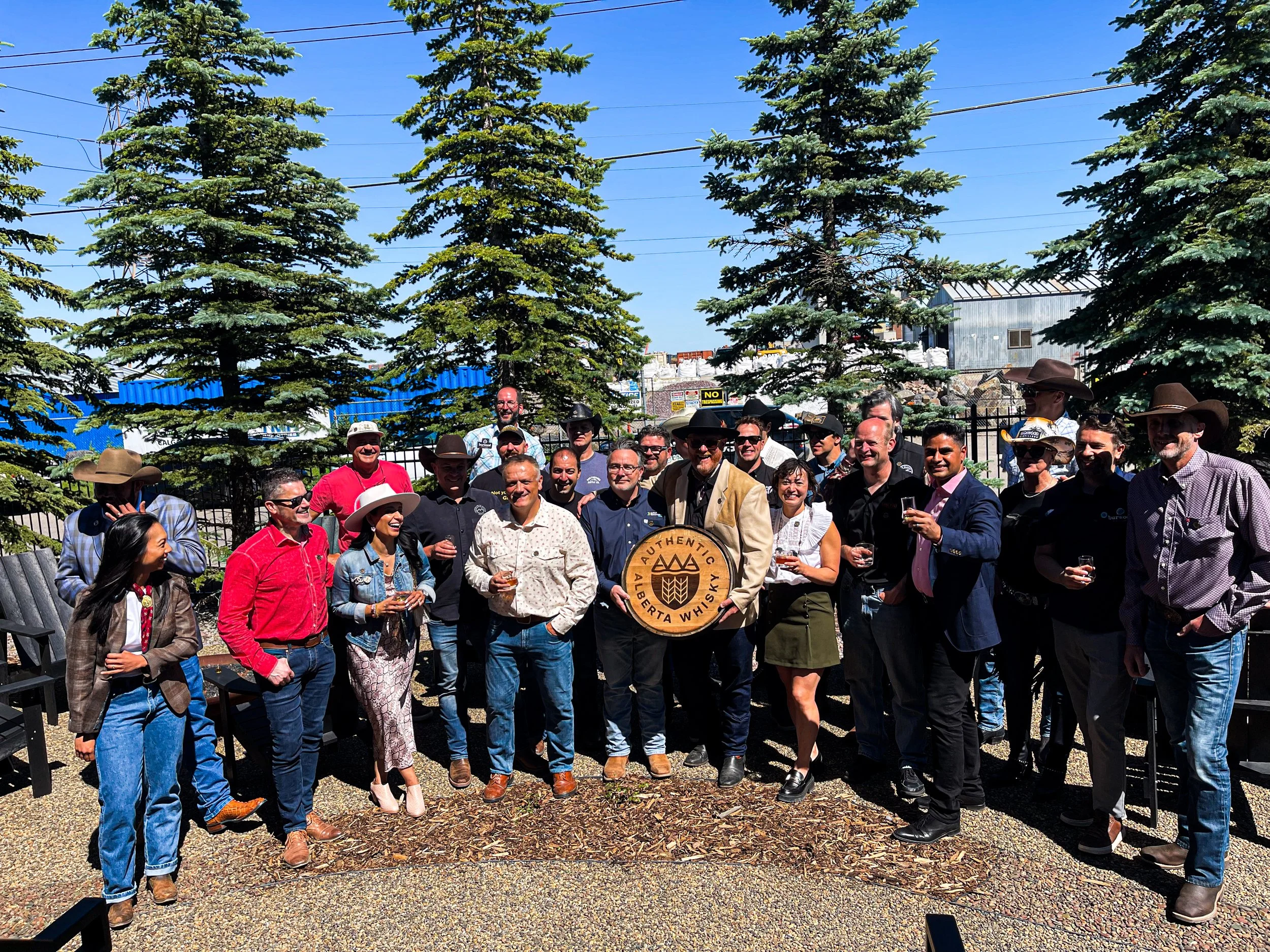
Alberta distillers gather behind the new Alberta Whisky logo at its official unveiling,
It's worth noting how differently a neighbouring province has approached this same instinct to define a category. British Columbia's Liquor Distribution Branch has its own long-standing Craft Distillery designation, but it is built almost entirely around scale and technique rather than geography: a BC craft distillery must ferment and distil its product on site using 100 percent BC agricultural inputs, cap annual production under 50,000 litres to qualify mark-up free, stick to traditional distilling methods, and skip neutral grain spirits entirely. It is a volume threshold with a local-sourcing condition attached, designed mainly to separate small producers from commercial ones for tax purposes.
Alberta Whisky is a different animal.
There is no production ceiling and no craft-versus-commercial split; a distillery the size of Alberta Distillers qualifies under the same origin-based rules as a two-person operation in Trochu, provided the water, the grain and the process all stay home. Where BC asks how much you made, Alberta is asking where you made it.
The unveiling was about more than a new logo. For Bryce Parsons, president of the Alberta Craft Distillers Association and CEO of True Wild Distilling, it marked a new level of confidence for Alberta’s distillers. "This puts us from being talented participants to confident leaders out there in the whisky world," he said. The new logo, he suggested, gives the industry a shared shield to carry into new markets. But he was just as careful to credit the less glamorous work behind it: bringing people with genuinely different interests into the same room, then choosing a collective vision over an individual one.
That broader significance was echoed by Via Dulay of Spirits Canada, who placed the Act in a national context. "It's an important new designation for distillers to signal the quality, the origin and the integrity of their brands," she said, calling Alberta Whisky a national first worth recognizing. She also made clear that the designation is only as strong as the work that follows. "Successfully implementing it will require continued collaboration, participation from all of you, and a shared commitment to maintaining the high standards consumers expect when they see the words authentic Alberta whisky."
The final note came from Scott Jespersen, chair of Alberta Grains, whose presence quietly underlined what sits beneath the legislation. Every requirement in Bill 24, especially the threshold for Alberta-grown grain, runs back through the farmers his organization represents. His role on stage made the point without needing to labour it: Alberta Whisky can only mean something if the supply chain behind it holds.
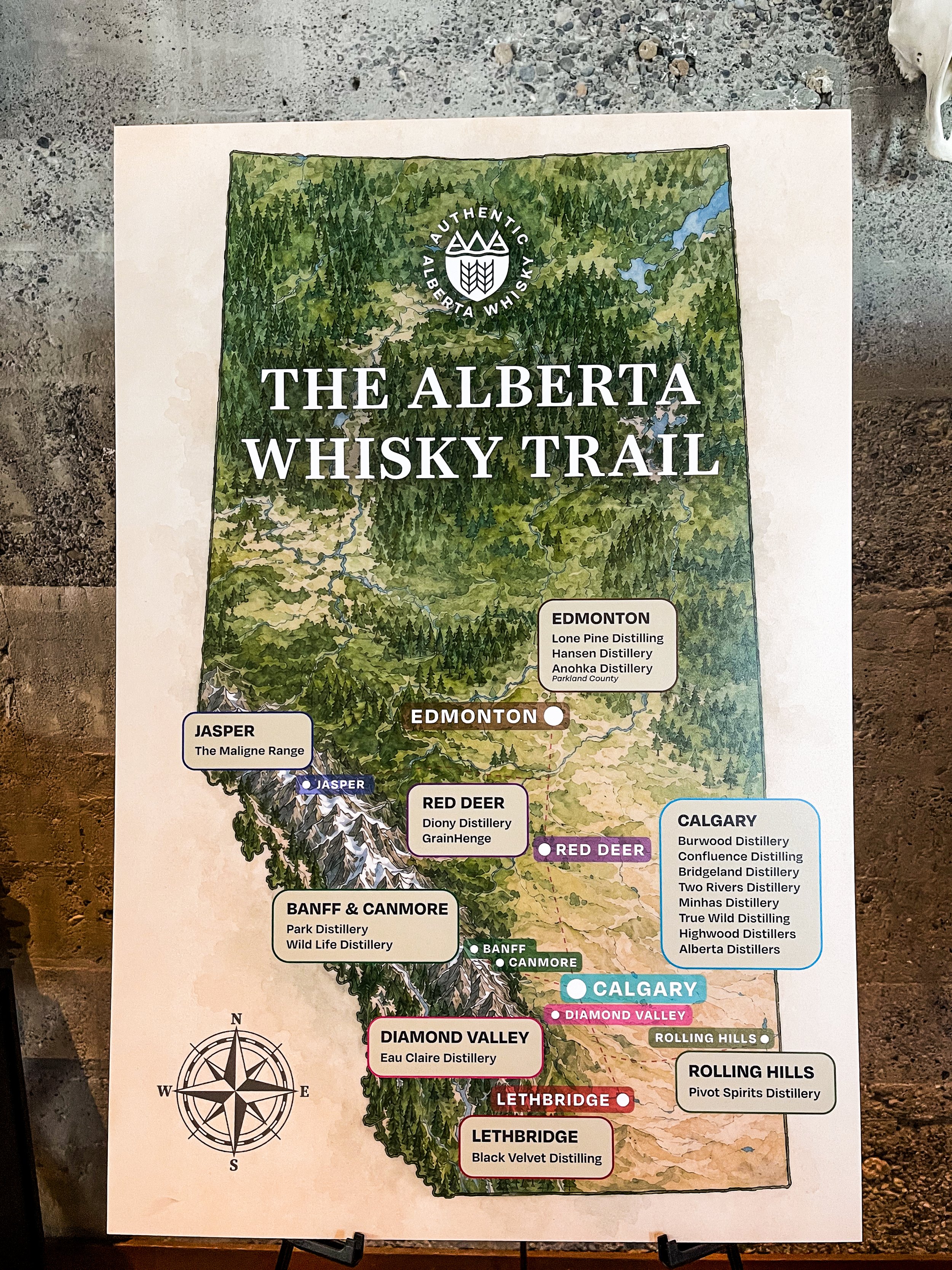
That forward work already has a name, even if it doesn't yet have a map. Nally used the unveiling to point industry toward an Alberta Whisky Trail, envisioned as a designated tourism route linking distilleries across the province, and noted that Travel Alberta has already issued a grant to begin scoping the idea. He was clear that government won't build the trail; industry has to define it.
Flavour Report readers may recognize the outline of one already. We mapped an unofficial version of it last November, seven Calgary distilleries within an hour of each other, each shaped by the same prairie grain and chinook-driven climate that Bill 24 now writes into law.
A formal trail wouldn't invent Alberta's whisky geography so much as put a sign on the highway pointing to something that was already there. The framing matches Alberta's broader tourism ambition of reaching 25 billion dollars in annual visitor spending by 2035, and for the province's more rural distillers in particular, a formal trail could be the lever that solves a location problem no amount of award hardware can fix on its own.
A logo cannot make whisky taste better. What it can do, if the province enforces it with any rigor, is make it easier for a drinker anywhere in the world to know exactly what they are paying for. Alberta has just bet its name on that distinction.