From Field to Flask: The Corn Connection
Corn’s journey from Ontario soil to the spirit that defines Canada

A truckload of Ontario corn being received at Hiram Walker before transfer into storage silos | Photo by Reece Sims
Canadian whisky may be synonymous with rye, but look behind almost every glass and you’ll find corn quietly doing the heavy lifting. It’s the workhorse grain of the industry, prized for its high starch content, approachable sweetness, and ability to form the backbone of blends. And nowhere is corn’s role more central than Ontario, where nearly two-thirds of Canada’s corn is grown. Corn thrives here thanks to the long, warm growing seasons that stretch across Southern Ontario’s fertile belt. Farmers track Corn Heat Units (CHUs) — a measure of accumulated warmth over the season — to predict how well their crops will ripen. With the right heat and moisture, Ontario delivers the kind of high-yield, high-quality grain corn that distillers depend on. Yet while Kentucky has built a global identity around bourbon and its corn fields, Ontario has never fully claimed corn as its calling card. That may be changing. The province has both the agricultural advantage and the whisky tradition to define a corn-forward style of its own, one that reflects local climate, farming, and craftsmanship.
This is the starting point for a story that comes full circle: corn planted in spring, harvested in fall, transformed into whisky, and then sent back to the fields as cattle feed.
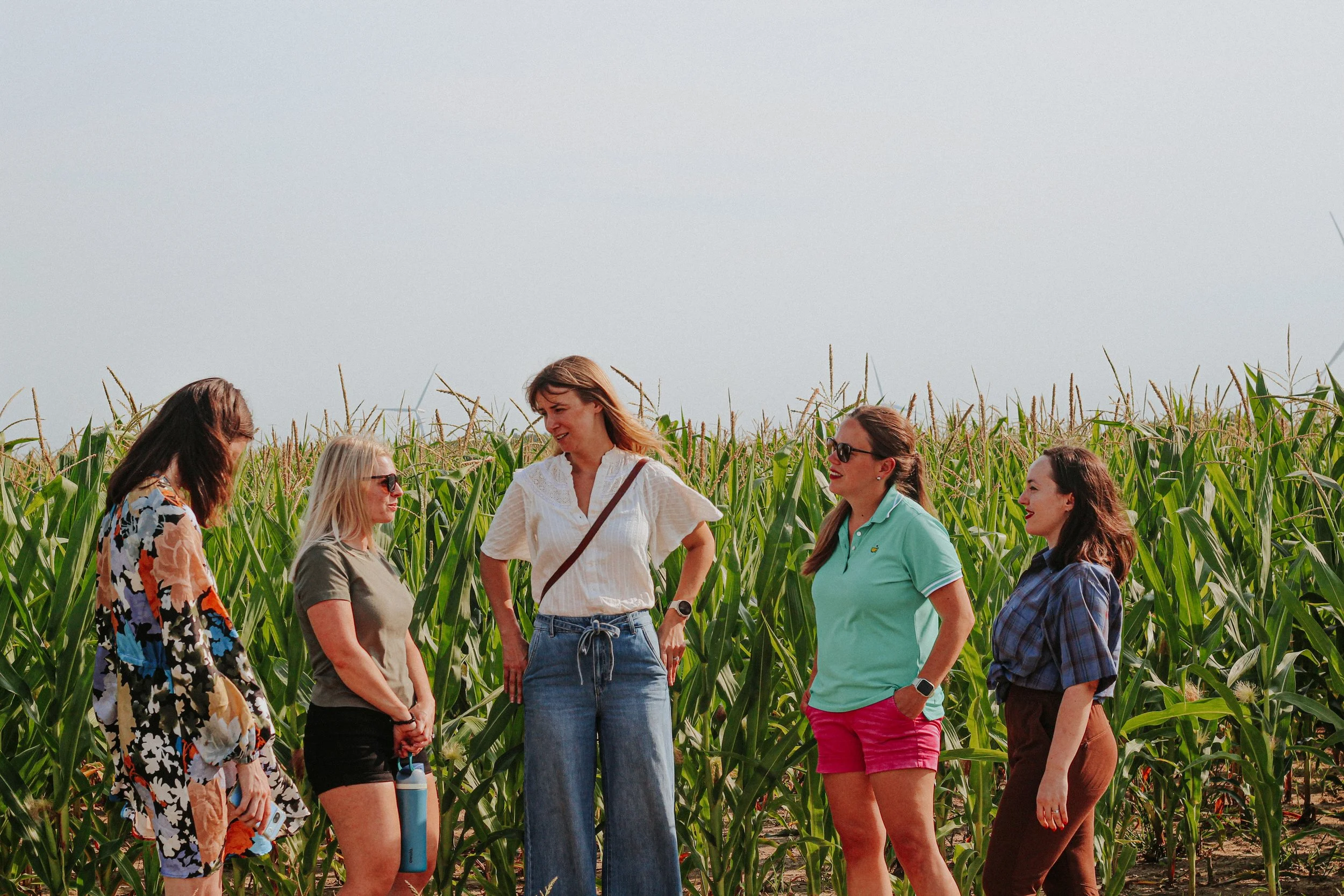
From left to right: Heather Storgaard, Grace Mulle, Dana Dickerson, Andrea Fujarczuk and Julie Federman tour the fields at Graceland Farms | Photo by Reece Sims
The Field: Growing Corn in Ontario
On the edge of Comber, Ontario, sits Graceland Farms, owned by fourth-generation farmer Grace Mullen, who supplies corn, among other cash crops, to Hiram Walker & Sons in Windsor. For Grace, farming is both livelihood and legacy. “We have corn as part of our rotation for diversification and the potential profitability it offers,” she explains. “Corn loves southern Ontario due to the growing season and the climate. The summers are hot, the soil is rich, and the lake winds keep the crops healthy.”
Her family plants in spring as soon as the soil warms. Over the summer, the stalks stretch higher by the day, soaking up CHUs that farmers watch like hawks. By October, combines rumble across the rows, harvesting grain corn that will head first to on-farm storage and drying. “Corn in Ontario needs to be 14.5 per cent moisture to be considered dry,” Grace says. “Corn will often be harvested at 20 to 25 per cent moisture. Having storage and drying on site is an advantage for us given the quantity we produce, and it’s a cost saving.”
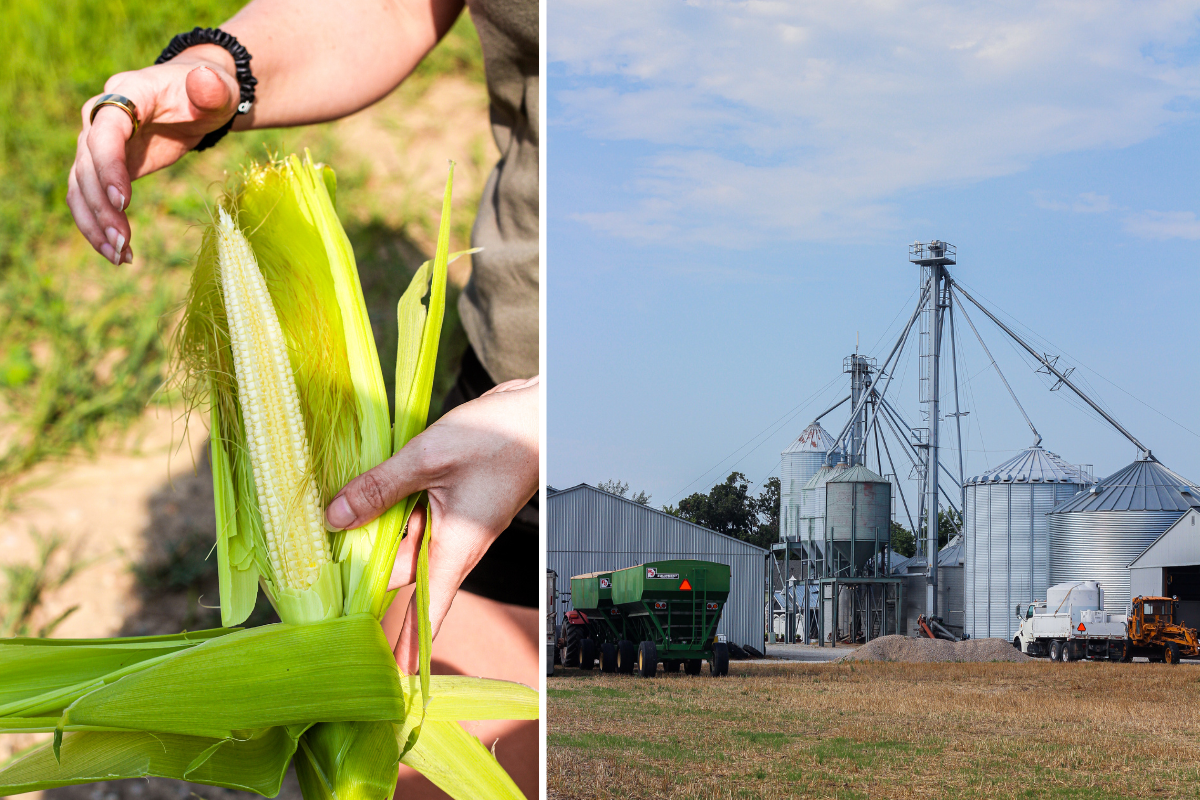
Graceland Farms
For whisky, not all corn is created equal. Distillers look for varieties with high starch and consistency, the kind that ferments cleanly into alcohol and leaves behind the characteristic sweetness Canadians expect in their whisky. Grace is proud to meet that standard. “We produce high quality grain and this is a standard for all grain in Canada. Ontario and Canada produce grain that is known worldwide for its quality and why many countries purchase grain from Canada.”
What makes whisky-bound corn particularly meaningful, she says, is knowing it goes to a local distillery and becomes a spirit people enjoy. “Seeing our grain turned into a product that connects directly with consumers makes the work especially rewarding.”
“Corn grown in Ontario is more than just a crop. It’s a cornerstone of our craft and a symbol of our commitment to local sourcing, quality, and innovation.”
The Gatekeeper: Receiving & Testing the Grain
Once harvested, the corn makes its way to Hiram Walker & Sons Ltd., one of the largest distilleries in North America. Here, the grain passes through the hands of Alice McLeod, Supervisor of Grain Operations. If Grace is the one who grows the corn, Alice is the one who decides whether it makes the cut.
On any given day, Alice receives around 16 truckloads of grain (roughly 800 metric tonnes) arriving from local farmers across the region. Each load is probed and tested on arrival, with a focus on three key factors: moisture levels, starch content, and cleanliness. Only when the corn meets those standards does it head into storage bins for whisky production.
There’s another, less visible test too. Corn can sometimes be affected by Gibberella ear rot, caused by the fungus Gibberella zeae (also known as Fusarium graminearum), which produces the mycotoxin deoxynivalenol (DON), commonly called vomitoxin. While DON does not carry through distillation into whisky, the concern lies in the spent mash that returns to farms as cattle feed. If contaminated, it could make animals sick. By screening incoming corn for vomitoxin, Alice’s team ensures not only that the whisky’s flavour remains true, but also that the local agricultural ecosystem stays healthy.
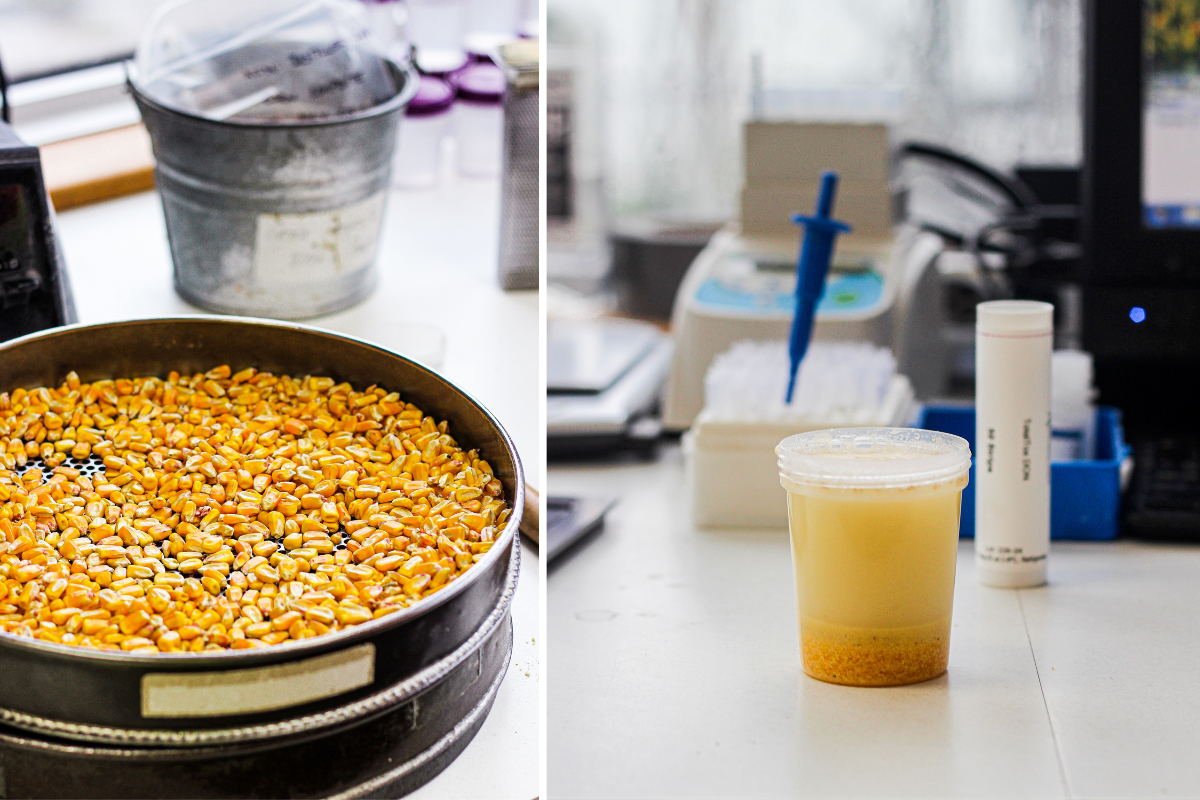
Corn undergoes multiple tests in the Hiram Walker laboratory | Photos by Reece Sims
The work may sound technical, but it’s fundamentally about flavour integrity. Off-notes in the corn can lead to flaws during fermentation; a bitterness here, a dullness there. By scrutinizing each load, Alice ensures that the corn and other grains entering the silos will ferment cleanly, setting the stage for spirit that’s sweet, smooth, and true to style.
The Transformation: From Corn to Spirit
From Alice’s grain bins, the corn travels deeper into the distillery, where Amy Levesque, Director of Distillation, oversees its transformation. Corn kernels are milled into a fine meal and mixed with water in giant mash tuns, where enzymes break down starch into sugar, creating a thick, sweet mash. Next comes fermentation: yeast is added, converting sugars into alcohol while producing subtle flavour compounds. After several days of bubbling activity, the mash resembles a beer-like wash, ready for distillation. It’s then boiled, condensed, and refined into new-make spirit, the foundation of many blended Canadian whiskies.
Corn’s role as the bedrock of blended Canadian whisky is unmistakable. It brings a creamy mouthfeel, rich sweetness, and notes that mature into vanilla, toffee, popcorn, and baking spice once oak works its magic.
“Single column distillation retains more of the grain’s natural character… double distillation creates a lighter, more refined spirit.”
Master Blender Dr. Don Livermore explains how distillation further shapes corn’s character: “Corn has long been a cornerstone of Canadian whisky production, valued for both its yield and its unique contribution to flavour. Depending on the distillation method, it can express itself in remarkably different ways. Single column distillation retains more of the grain’s natural character, resulting in a whisky that’s full-bodied, flavourful, with notes of sweetness, cooked cereal, and fresh vegetables. Double distillation creates a lighter, more refined spirit, subtle and citrusy, ideal for balancing the bolder notes of rye in blended whiskies.”
Ontario corn doesn’t just grow well in the field, it performs just as reliably in the still. From the producer’s standpoint, Dr. Don Livermore mirrors Grace’s pride in quality, noting that the starch-rich grain she grows ferments cleanly and consistently into the spirit that underpins Canadian whisky. As he puts it, “Corn grown in Ontario is more than just a crop. It’s a cornerstone of our craft and a symbol of our commitment to local sourcing, quality, and innovation.”
Don’s pride in Ontario corn extends beyond its flavour potential to how the distillery handles what’s left behind. After distillation, the story doesn’t end in the warehouse. The spent mash, known as distillers’ grains, is loaded back onto trucks and sent to farms as livestock feed, a return journey that only works because the corn is carefully screened at intake for issues like vomitoxin.
By ensuring quality from the start, the distillery protects both the whisky in the glass and the animals that rely on its by-products. At Hiram Walker, this cycle has been refined even further. Don explains, “We are deeply committed to environmental responsibility and sustainable practices. Traditionally, drying distillers’ grains for feed is both energy-intensive and carbon-heavy. By transitioning to wet distillers’ grains, we’ve significantly reduced our carbon footprint. Partnering with forward-thinking agricultural operations that can use them efficiently not only minimizes energy use but strengthens our ties with the local farming community. It’s a win-win for the environment and the region.”
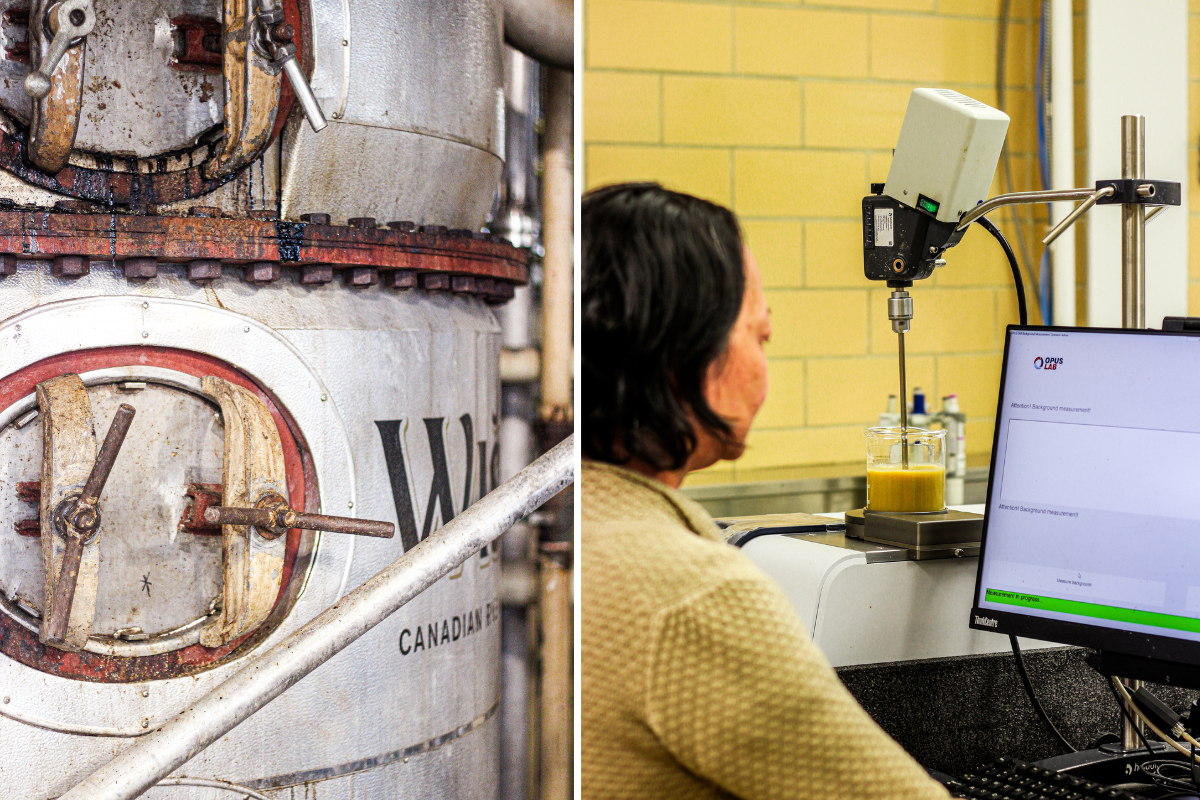
Distillation and testing at Hiram Walker | Photos by Reece Sims
From Soil to Still… And Back Again
The journey of corn in Ontario whisky is a story of land, people, and flavour, but also of community and ecology. From Grace’s fields to Alice’s grain tests to Amy’s stills, every step reflects a careful balance of tradition and innovation. Once distilled, the spirit moves into the hands of Dr. Don Livermore, whose role as Master Blender is to shape these corn distillates into exceptional whiskies, balancing sweetness, spice, and oak into products that define Canadian style.
And when the spent mash returns to the farm, the circle completes: what began as grain becomes whisky, and what remains nourishes the very animals raised on the same land. That closed loop is more than efficient, it’s a living ecosystem. Farmers depend on the distillery, the distillery depends on farmers, and together with the blender who completes the cycle in the bottle, they sustain not just a regional industry but a way of life that’s uniquely Southern Ontario. Whisky here isn’t abstracted from its environment; it’s inseparable from it.

A lineup of whisky samples prepared for blending trials at Hiram Walker.
Looking South Looking Forward
In Kentucky, corn is more than just an ingredient, it’s part of an identity. Bourbon, by law, must be made with at least 51 per cent corn, and the state’s narrative is woven around its cornfields and limestone-filtered water. That story has given Kentucky bourbon a global reputation as a spirit inseparable from its place of origin. Ontario, meanwhile, grows more corn than anywhere else in Canada, yet hasn’t fully claimed it as a whisky-defining trait. Corn here isn’t just abundant; it’s exceptional.
Beyond Hiram Walker, craft distillers are beginning to signal a shift. Spirit in Niagara nods to bourbon with its Brrrbon while putting an Ontario stamp on it. Last Straw Distillery leans into corn identity with sCorn Whisky, marketed as ‘spiteful Canadian corn whisky.’ Barnburner Whisky, from Maverick Distillery, is a double-aged Ontario corn-and-rye expression described as ‘a little bit bourbon, a lot Canadian whisky, and completely its own thing.’ Taken together, these highcorn whiskies are smooth, approachable, and help carve out a distinct Ontario identity.
These examples raise an intriguing question: could Ontario turn corn into its calling card, the way Kentucky did with bourbon? At a time when U.S. whiskies are off LCBO shelves due to trade tariffs, the opportunity is sharper than ever. Ontario doesn’t need to mimic America; it can carve its own path, with a corn-led style that reflects its climate, farming traditions, and circular grain-to-glass ecosystem.