
Dillon’s Distillery: Big Hair, Bigger Dreams


Dillons Distillery’s Rose Gin and Black Walnut Amaro are featured in the Flavour Report Edition 01. Learn more about the Rose Gin here and the Black Walnut Amaro here.
People often say, “look for the hair” when trying to find me in a crowd. At Dillon’s, that didn’t work as Geoff Dillon’s wild mane gave my own a run for its money. But beneath the memorable coiff, what stood out most wasn’t style. It was substance. Dillon’s story is one of stubborn innovation, quiet rebellion, and an unwavering obsession with rye.

Reece Sims and Geoff Dillon pose with Edition 01 of the Flavour Report magazine
From Biochemistry to Barrels
Geoff Dillon was just 21, midway through a double major in biochemistry and economics at Western University, when he first sketched the idea of opening a distillery. He’d already been experimenting with wine and beer at home, but whisky was the real dream. Not just any whisky either. As he puts it:
“I wanted to make rye whisky in Canada, not Canadian rye whisky.”
That distinction is more important than it sounds. “Canadian rye whisky” is a category that can mean many things, often blends with only a small amount of rye. Geoff’s vision was laser-focused: 100% Ontario-grown rye, distilled and aged with care.
The challenge? In the early 2010s, Ontario’s laws made small-scale distilling nearly impossible. Until 2015, you couldn’t open a distillery and retail shop unless you owned a 5,000L commercial pot still — prohibitively expensive for a craft startup. Dillon’s workaround was both brilliant and cheeky: he commissioned a German stillmaker to build the world’s first hybrid still, placing a 450L working still on top of a 5,000L shell. Legal box checked, dream unlocked.
By 2012, Dillon’s Small Batch Distillers was officially open and was one of only a handful in the province at the time.
Canada’s Largest Independent Distillery
Fast forward to today: Dillon’s is now the largest Canadian-owned distillery in the country. Their lineup is broad from dry-style gin, melon gin, bitters, black walnut amaro, vodka, and more, but rye remains at the heart of the operation. And not just any rye. Ontario-grown rye paired with Ontario-grown grapes (for a few non-whisky products), highlighting the terroir of their home province.
The house style leans into three key barrel types for their core rye whisky:
• ~50% first-fill ex-bourbon
• ~25% new American oak
• ~25% Ontario oak
What’s fascinating is the last one. While Ontario and American oak are technically the same species (quercus alba), their growing environments are drastically different. Colder winters, shorter seasons, and tighter grain structure in Ontario results in flavors that lean more herbal, minty, and spiced compared to the caramel-vanilla-forward American oak.


A Hands-On Blending Session
After the distillery tour, we headed into the tasting lounge for a mini masterclass where we tasted through five expressions of 100% rye, then blended our own 200ml bottling.
The five samples (all 4–6 years old) revealed just how much influence wood has on whisky:
• First Fill American Oak – Eucalyptus, sawdust, almond kernel, caramel.
• New American Oak – Spicy black pepper, vanilla, nougat.
• Ontario Oak – Anise, mint, spiced vanilla, nutmeg, floral lift, subtle marshmallow.
• Oloroso Cask – Red fruits, leathery cocoa, warming spice.
• Port/Paxarette – Chocolate, cinnamon, dried fruit, with a faint sulphurous note.
Blending them wasn’t about chasing balance, but about understanding how each cask tells its own story. Some were bold, some delicate, some decadent. Together, they showed how Dillon’s dream of rye can splinter into a hundred different directions. I personally wanted to lean heavy on the Ontario oak in my blend, because it’s something unique.


The Final Sip
Dillon’s isn’t just a distillery; it’s a reminder that Canadian whisky doesn’t have to be hemmed in by its history. Born from a loophole, built on innovation, and fueled by local grain, Dillon’s is shaping the next chapter of rye in Canada.
And as for the hair? Let’s just say it’s fitting. Wild, unruly, and impossible to ignore — much like the whisky itself.


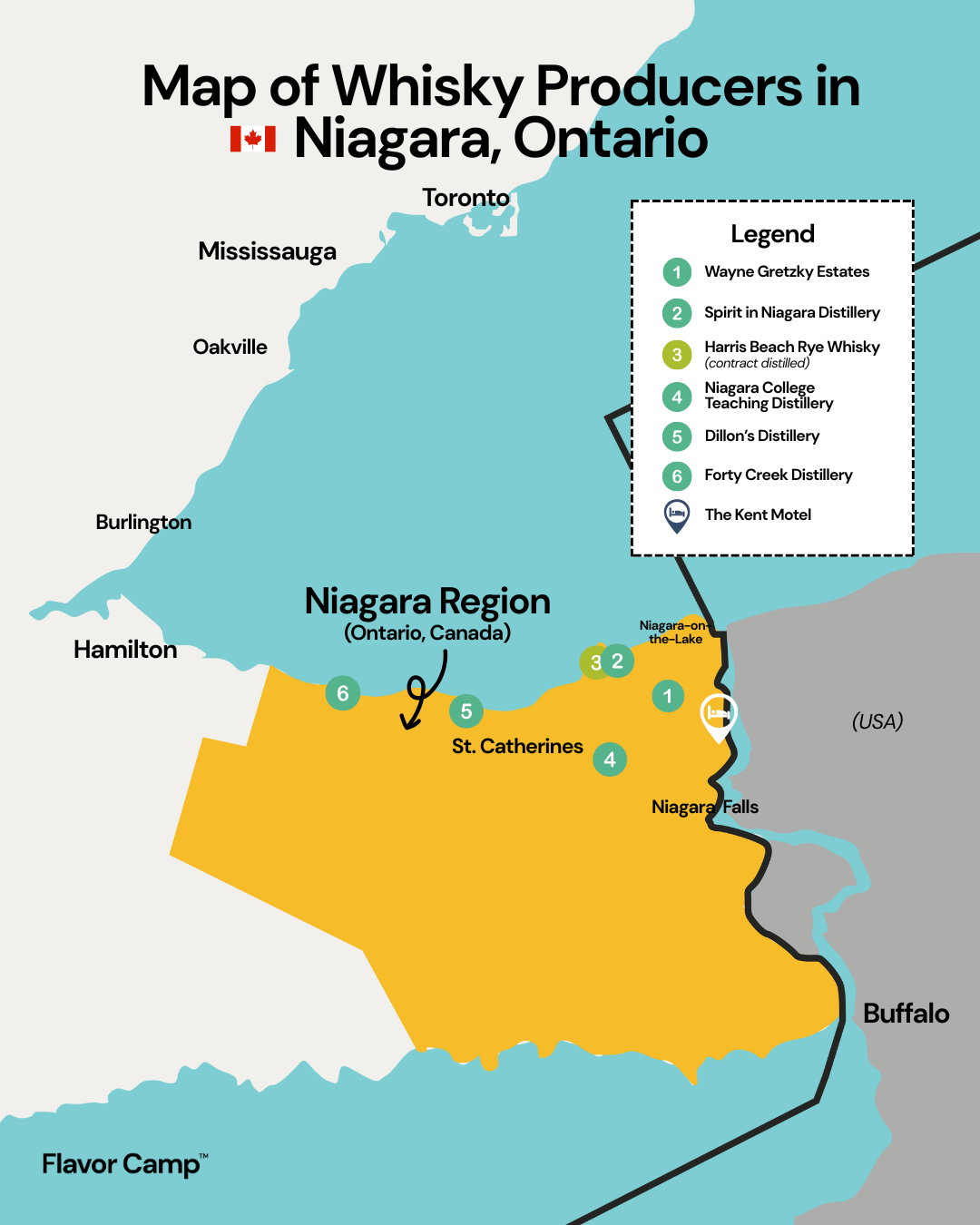
This Field Note is part of a series as we explore whisky producers in the Niagara Region of Ontario, Canada.